Monday, November 30, 2009

Am I the only one not excited about this?

So much has been happening over at CERN. Birds dropping baguettes into electronics, theories about saboteurs from the future, and, at last, a successful startup. After years of waiting and anticipating, the thing works. Tons of press, much ballyhooing.

So why haven’t I written about it? (not that anyone is waiting to hear my thoughts, of course). I think I’ve been avoiding it. After following the story for five years on this side of the Atlantic, I must confess a part of me was a little disappointed to see CERN working at last. Why? Because it really does finally start the death clock for my favorite particle accelerator, the quirky, irascible, buffalo-loving, plaid-tie-wearing, held-together-by-baling-wire-and-duct-tape, 40 year-old local curmudgeon that cranked out discovery after discovery: The Tevatron at Fermilab. And anyway, who has the cooler name? The LHC? So boring. The Tevatron! Now that’s what science is supposed to sound like.


The Tevatron. No, not CERN. The TEVATRON.

We, my co-filmmakers Monica Ross and Andrew Suprenant and I, spent a good four years going back and forth from Chicago to Fermilab, getting to know I-88 quite well. We became regulars of a sort, walking in and out of the buildings and labs, waving to physicists and engineers we had come to know, and eating at the Fermilab cafeteria. They were hot on the heels of the Higgs boson. Well, not all the time (you’ll have to watch The Atom Smashers to find out about the roller coaster ride), but suffice it to say that they were neck and neck with CERN for the honors of finding the most sought-after subatomic particle of all time. And just when their big rival, the enormous, expensive, glorious LHC at CERN was set to blow them out of the water, the Europeans had a hiccup (ahem). The Tevatron had a new lease on life! And another year, maybe two, to make a discovery.

But now, the LHC is finally working. Hooray.

I know, the scientists at Fermilab are just as excited that the LHC has started as the scientists in Europe. After all, they will be heading over there soon to start work, if they haven’t already. They love the big new toys. And Fermilab has a lot of game —- many things are going on besides the beat up old Tevatron (as our new Fermilab film will demonstrate!) It’s just —- I really like the Tevatron.

What can I say —- I have a 1969 VW bus. Just about the same age as the ol’ Tevatron. I’d have a hard time getting rid of it, too.

Friday, September 4, 2009

Hello again!

Well, it's been a long, long time! Apologies for the delay. We've been incredibly busy on our next film, called The Experiment. As yet, we have to keep it under wraps, because the people involved are quite touchy. I've been itching to write about it, and even to set up a new blog for it, but suffice it to say many of the people talking to us are skittish about speaking in public. They are worried about the wrong kind of publicity, so we have to approach them with some caution. We've been using The Atom Smashers as evidence that we are conscientious filmmakers, and have been honest and direct, and have met with mostly success. However, just the other day, someone we contacted about an interview declined because he only would feel comfortable speaking with "established media outlets." It's been a pretty wild ride --- when we get through with production, I'll start a new blog and direct you to it.

On to other news, though --- we have a new office! We haven't moved in yet, but here are some pictures, courtesy Stef Foster (who shot most of the pretty shots in The Atom Smashers)
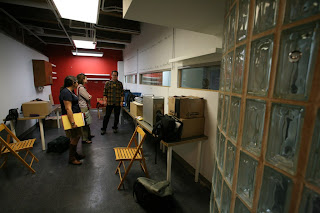
It's long and narrow, but works for us... this is Amy (our new assistant editor volunteer), Carole (our new Associate Producer), and me. As you can see, we don't have any furniture yet, except for the tables and some shelves. We'll end up with about three workstations when all is said and done.


This is Peter, our grants / funds coordinator, and Monica (co-director). The writing on the wall was left over from the previous tenants in this space, who were a printing company. They've agreed to make us business cards and letterhead ... for free! Very lucky for us. The building manager has scraped off all the writing by now ... a tedious job.


As part of the deal we have access to a really nice conference room for our board meetings. Here's Monica underneath a cool feature of the building --- the owners have a million dollar + collection of old posters, some of which are 12 feet tall. They're incredible. Makes for a really nice environment. The only problem is this room is a little dark --- there are about 20 small halogen lights and all of them except 2 are burned out. From what we understand, we're the only ones interested in using this space; most of the other tenants have their own conference rooms, so it's likely no one has noticed. I have a feeling they'll fix them once we point it out. There's also a 4th floor outdoor deck with a great view of downtown...

Here's the other end of the board table, with Peter, Andy (one of our board members), and Carole. And finally, Andrew, very excited.


So, despite the fact that this blog has been virtually ignored for a couple of months, we've been extremely busy! Also, we will soon be sending out mailers across the country to high schools, museums, and science labs to try to acquire some screenings. We've got a 15-minute postscript to the film that will bring many of the events up to date, as well as some teaching materials. I'll likely be creating some more posts as that happens.

That's the latest --- look for more soon!

Sunday, May 10, 2009

How many anti-protons does it take to screw in a light bulb?


Reading in my favorite magazine, Scientific American, I saw an inevitable confluence: Star Trek + Fermilab. As I'm sure you know, there's a new star trek movie coming out. Anyone who has ever watched Star Trek knows that they talk a lot about anti-matter. Anti-matter powers the Enterprise's warp drive, as well as provides the oomph behind the "photon torpedoes." Anti-matter is also used at Fermilab: they smash protons and anti-protons together. So Fermilab has an anti-matter factory.


A guy named Lawrence Krauss wrote The Physics of Star Trek, which I have never read, but assumed was a silly book about how everything you see in Star Trek is possible and "some day, you'll be 'beaming' back and forth to the beach on your own personal transporter!'" Scientific American interviewed him about the new movie, and I found him to be refreshingly frank, and apparently brutally honest, most of the time saying variations on "it's an interesting idea, but ain't gonna happen." For example, the above-mentioned confluence:

Of course, it's hard to create antimatter, much less carry it around. It takes a tremendous amount of energy to produce antimatter. If we used the antimatter-making device at Fermilab just outside Chicago, the energy cost would be many thousands of times the gross national product of the U.S. to produce enough antimatter to light up a lightbulb.

That's an expensive lightbulb. Although, the way the economy is heading, China can probably order a few dozen before too long.


PS: information about that incredible image of antimatter can be found here

Friday, April 24, 2009

California here we come

Monica and I are flying out to Davis, CA, over the weekend as the guests of John and Robin (the married physicists in our film). Well, I guess technically we're the guests of the University of California, Davis, which is screening the film. We'll be participating in a panel discussion afterwards. We're really excited! I'll post from the road, including some pix.

Saturday, April 11, 2009

Ghostly release


As I mentioned before, Kate Simko composed the music for The Atom Smashers. The soundtrack is now available! It's a digital only download, which means that although you can't hold it in your hands, you can get it immediately. Here's a link to the album release, where there's a nice review (including my favorite part where the track 'God Particle' is called a "woozy minimal-house banger").

Also, all the tracks can be previewed online!

In the event you have swallowed a Higgs Boson

Scientists can do the funny, too. Here's what to do if you think you accidentally ate a Higgs. Best lines: "If space and time have inverted within your body, skip to step 10." and "Do you feel protons decaying? Grand Unification may be occurring near your vital organs."

But here's the best found on Abstruse Goose:


Finally, scientists at CERN saying what they really feel: "Run and hide, asshole. We're pissed." The sweaty higgs boson makes my day...

Saturday, March 28, 2009

Good budget news, for once


On March 23 Pres Obama started to make good on his commitment to supporting science. It's supporting neutrino science, which has nothing to do with the search for the Higgs boson, but some of it can go towards infrastructure improvements at Fermilab, which got $34.9 million. Fermilab's neighbor, Argonne National Lab, will get $13.1 million.

Remember in our film when John Conway and Robin Erbacher are sitting in a restaurant, talking about the budget cut they just experienced? (If you only saw the PBS version, alas, this scene had to be cut for brevity). They were lamenting the fact that the DOE (under the Bush administration) didn't really seem to support them, either financially, or (strange to say it), spiritually or philosophically. The administration tried to establish performance measures, a kind of business-model approach to science that is fundamentally at odds with the type of big-picture research going on in the search for these kinds of answers. In a strange way, it's as if a CEO approached an artist and said "OK, let's quantify how you go about painting masterpieces. How many masterpiece ideas will you be generating per week? How many brushstrokes per masterpiece? What is your brown-to-red ratio when it comes to creating the mood 'somber'? I'd like to have your answers in an excel spreadsheet by tomorrow morning." The CEO, on a fundamental level, doesn't "get it."

Not that I have anything against CEOs or am implying that they don't understand the more subtle aspects of life. It's just that, in a strange way, I think artists and scientists find themselves in similar situations: in passionate pursuit of something that people with the money they need don't often understand (something my co-director Monica has said for years). On our Netflix page, there are several reviews. We've got a 3.6 star average rating (up from 3.5!), which I'm pretty pleased with. Most of the viewers who took time to write something were pretty positive, but there are some real gripers out there who were not pleased with the film at all. Some of them seemed to react quite negatively to scenes such as the one I described above, where John and Robin were sitting in the restaurant, opening up about their feelings, calling them naive or petty, accusing them of whining and having myopia about the real world. I certainly wouldn't argue with any critics; they are certainly entitled to their perspective. However, I would say that we give scientists precious little space for personal feelings. Much of it undoubtedly has to do with the fact that they are spending lots of public money on things most of us don't understand.

Did you see the movie "Big Night?" It's about a small Italian restaurant in New Jersey run by a couple of brothers. One brother is an exacting chef and the other is the manager. The chef (another iconoclastic misunderstood genius) chafes when clunky regulars come in and ask for a meatball with their spaghetti, or want pasta AND risoto. Whom do you identify with, the chef or the customer? No one likes to be sneered at as a rube. But everyone can relate to the feeling of "they just don't GET it!", whether it be trying to simplify a procedure at work under a dense boss, trying to appeal to a flat-voiced agent at the city auto permit desk, or a kid trying to explain to a shrugging parent why wearing teddy-bear sweaters might have been fine at age 12 but is not an option on the first day of high school.

So, I guess my point here is that finally, finally, Fermilab (and Argonne, and Sandia labs, and Los Alamos, and SLAC, and Brookhaven, and...) can feel like their boss "gets it." They know that meatballs are an American invention. That using email will be faster, better, and cheaper than typing and mailing. That paying for all three tickets NOW instead of coming back three consecutive Tuesdays will be faster and better for everyone. And that, as counter-intuitive as it might seem, even though it's perfectly good, and that years ago parents wore the same sweater five years in a row, and that people in Africa would be thrilled to have a quality sweater like that, spending a few bucks on a new sweater now will pay dividends for years to come in terms of mental health (and those people in Africa can actually get this quality teddy bear sweater ... after it has been donated to the thrift store!)

I can almost feel the pulse rate of scientists across America starting to slow a bit. Relax? Not quite yet. But anyway, shouldn't we let them fret and complain a little like the rest of us? That was a big thrust of our film --- to show that they're just like everyone else. They just use some longer words sometimes. OK, and they're not such good dancers. Well, and maybe their jokes aren't necessarily funny to everyone. And...

Tuesday, March 10, 2009

At the Lake County Film Festival

We haven't gone to many film festivals lately, but there was a smallish one about 90 minutes north of us that showed our film, so I went up there on a Friday night to be "film co-director in attendance for Question and Answer session after the screening." There was a crowd of 20 or so who asked thoughtful and engaging questions afterwards.

But during the film, I felt myself growing anxious --- I knew how it would end, which you would think would remove anxiety. But the problem was that I knew the film would end in, essentially, the spring of 2008. A lot has happened since then! We have a new president, a new attitude towards science, and, especially, a roller-coaster ride of developments in the search for the Higgs boson. I was frustrated on one hand, but knew that we had a very precipitous sense of timing about when The Atom Smashers was released. I just found myself in the audience wishing that we were working on a sequel! But that would amount to diving full-time back into filmmaking mode, without a definite plan... something we're not really prepared to do.

However, I'm strongly considering doing a "post-script" of some kind. Getting the camera back out, maybe doing just 2 or 3 interviews and finding a couple of news clips (i.e. President Obama saying he will restore science to its rightful place in government). Not sure what we would do with this, except perhaps ship it along with the DVD. Or, perhaps make it available for downloading online, and include instructions on how to do that with each purchase... hmmm... lots of possibilities...

All I know is that I sat in the audience and sent Monica a text message that read "we DEFINITELY have to follow up --- we've spent too much time and energy on this story not to document the final chapters!"

All kidding aside... go Corolla, go!

Things are starting to get very interesting.

In February a spate of articles started showing up, first starting with the realization that CERN was not going to recover from its near-catastrophic breakdown in the summer as expected, but would need until September. Because it was a later start, the decision was made to keep CERN running through the normally scheduled winter break --- to basically run the thing non-stop for a year to try to make up lost time.

This announcement seems to have started a chain reaction of articles that promoted the idea that CERN's stumble last fall could have dire consequences for the massive particle accelerator. As our film pointed out, Fermilab's Tevatron has been cranking at full capacity for some time now. It's a little like having a $100,000 Porsche on the shoulder with its hood up while a $6,237 Toyota Corolla hums along at 80 mph. Even though the Porsche could blow the Toyota's doors off, if it sits out of the race long enough, guess who will win?


So, first we saw the article I referenced in a previous post, and here's one from the NewScientist, called "Fermilab 'closing in' on the God particle." (It's an interesting exercise in nuance when discussing the concept of competition between the two labs. Pier Oddone is quoted as saying "we're not racing CERN" yet the very next sentence says "Other scientists at Fermilab ... [say] the sense of competition is real." And how's this for spin: "'Indirectly, we're helping them,' says DZero spokesman Dmitri Denisov of his European counterparts. 'They're definitely feeling the heat and working a little harder.'" That's a little like the driver of one race car say he's helping the other race car driver when he guns his engines at him.)

(Incidentally, this racecar analogy is all over the place: In an article called "Fermilab, European accelerator race for glory" in the Chicago Tribune says "The idea Fermilab could pull ahead in the Higgs search seemed about as likely as a Model T beating a Corvette in a drag race." (Further evidence is the fact that this story has been mistakenly filed under the "Sports Archives" section).

But just three days ago the rhetoric in the media stepped up a notch. Monica sent me this article from Newsweek, called "God's Broken Machine" (oh, the drama). The subhead reads "As Europe makes repairs to its shiny new particle accelerator, U.S. rivals prepare to steal the prize," and a later line reads "phyiscists at the world's biggest particle accelerator, the Large Hadron Collider in Geneva, are seeing their dreams of Nobel Prizes go down the drain..." due to Fermilab's "exploiting the lull by staging a last-minute comeback, threatening to leapfrog the Europeans to the prize."

Now, hold on. Aside from the ridiculous idea that Fermilab is staging a comeback, as though they huddled around and decided to suddenly launch an aggressive play, this is sounding typical of media hyperbole. But there's a little more to it:

This week scientists at Fermilab in Batavia, Illinois, will announce new data that not only narrows the gap between them and the coveted God Particle, but also suggests that the LHC may not be particularly well placed to make the discovery at all. The finding is a public-relations blow to the LHC and tarnishes Europe's newly burnished image as a leader in Big Science.

I asked John Conway what this "new data" was, and if it was related to the press release from Fermilab we were emailed yesterday (yes, it's fun to be on Fermilab's press release list, the same list with the Associated Press, The New York Times, Scientific American, The Washington Post, MSNBC, Discovery, etc.!) that announced Fermilab had discovered a single top quark. Nope, not related. The "new data" is new results from the Higgs search.

Without going into the details of the science that I don't understand, I'll jump back now to the newsweek article to give us an idea of what this new data implies for the search (race) to find the Higgs particle:

The standard model predicts that the Higgs will fall within a range of energies—from 114 giga-electron-volts to 185 GeV. The LHC is, without question, master of the upper portion of that range. Using it to hunt the Higgs at the lower energies, however, would be like shooting quail with a cruise missile. Fermilab's smaller Tevatron collider, it turns out, may be better suited. The Higgs, the new Fermilab data show, does not exist for a portion of the upper range, putting it in the Tevatron's cross hairs and suggesting that the LHC may be more peripheral to the search than previously thought. "We've made their jobs a little bit harder," says Fermilab physicist Dmitry Denisov, "because we've excluded the region they're good at."

Ah. So, in a sense, the Toyota Corolla has just revealed the racetrack doesn't have any straightaways where the Porsche would really have a chance to blow it away. Instead, it's mostly narrow, curving suburban neighborhood streets with children playing and beige houses, perfect for the Corolla.

It gets more complicated here, as there are actually two types of Higgs that might be out there: Standard Model ones like those mentioned in the Newsweek article, and supersymmetry Higgs, which is what John Conway has been looking for. From what I can understand, the Standard Model ones are less likely (perhaps a 50% chance in two years), while the supersymmetry kind are more likely.

I think that's the reason for the range of 50-96% that the BBC article mentions. Whew. No wonder media people (read: me) like to use simplistic analogies like Corvettes and Model-Ts, Davids and Goliaths, and Porsches and Corollas. And why scientists get so frustrated with us.

Go Corolla, go!

Thursday, March 5, 2009

Higgs boson found!

It's been found by three gradeschool kids with an accelerator they build in the hallway of their junior high school. Really. It's on the Interwebs, so it has to be true, right? Read all about it. CERN and Fermilab researchers are rumored to be considering "chucking it all in and starting a band."

Tuesday, February 17, 2009

50/50 at worst, 96% at best

These are the odds that Fermilab will find the Higgs before CERN. At least, according to Fermilab, as quoted today in this article from BBC News. The subhead of the article reads "Europe's particle physics lab, CERN, is losing ground rapidly in the race to discover the elusive Higgs boson, or "God Particle," its US rival claims."

Later in the article comes this line:

"Project leader Lyn Evans conceded the enforced downtime might cost the European lab one of the biggest prizes in physics."

I've mentioned before that Ben Kilminster, wearing his batman T-shirt, half-jokingly said that Fermilab was in a race with CERN but they needed CERN to "trip a little bit. Stumble." Back when CERN had its breakdown, in the fall of 2008, I don't think anyone expected the ramifications to be quite so huge. Remember, some people say that the entire construction of this new version of CERN was done to find the Higgs. Others will point out that there is much more science that will be done than that one discovery, but no one could deny that the Higgs is a main motivator. So when it became apparent that CERN was out of commission for a full year, I suspect the worrying began. This wasn't CERN tripping a little bit; a stumble. This was turning out to be a headlong sprawl.

As Leon Lederman, John Conway, and others said in our film, the Tevatron is now a finely-tuned, thoroughly tested race car, purring along on eight cylinders, with a pit crew of battle-hardened mechanics standing by who know every nut and bolt by heart. If ever there was a moment for it to take the lead and claim the prize, this is it.

The article states something quite stunning:

"Fermilab estimates that the Tevatron has already picked out about eight collision events which may be hints of the Higgs."

Sounds like there's a potential that by summer this could finally be in the bag... stay tuned for further developments...

Friday, February 6, 2009

New Hampshire Public Radio

And here's a link to a slightly more erudite interview Monica did with New Hampshire Public Radio's Word of Mouth show. They do a really nice job of introducing the story, including playing some clips from the film like they did at our Chicago NPR show (but they get monica's last name wrong. It's the price of fame.)

Grok

Here's a link to a rather lengthy interview I did for an online science radio show called Groks Science Radio. At the end of the interview, they asked if I'd like to play a game called Grokatron 5000. This is where they ask a question, generated by their super computer (ahem). The question was "Massive or Insubstantial?" I was asked to rate each of 5 people as being either massive or insubstantial. The five people were: Bill Gates (windows = insubstantial, but philanthropic work = massive). Jerry Springer (again, first half of his life in politics = massive, TV show = insubstantial), Stephen Hawking (massive, of course), Paris Hilton (insubstantial), George Bush (unfortunately massive).

Why? Because the Grokatron asked. I answered.

Friday, January 30, 2009

Vote!

Quick --- if you're so inclined, go vote for The Atom Smashers audience award on PBS! The opportunity to vote disappears quickly, so hurry!

Thanks!

Tuesday, January 27, 2009

Talkback!

The Atom Smashers is broadcasting again tonight (Tuesday, January 27th) in an encore showing on many PBS stations. We found out from PBS that the film is screening in the Los Angeles area for the first time tonight, as they were in the midst of a pledge drive in November when it originally aired. So, to any west-coasters, welcome! And to everyone, please visit the PBS "Talkback" page to write your thoughts about the film. And please visit here to buy your very own copy (an extended version with 6 extra features), and we'd love to discuss setting up a screening with your school, museum, lab, club, or whatever organization you've got.

Sunday, January 25, 2009

Ghostly congratulations


Great news for our esteemed soundtrack composer, Kate Simko (and us, indirectly): The Atom Smashers soundtrack will be released on Ghostly Records! Kate has a great career going as a composer and performer, and I've gotten so many compliments about the soundtrack of the film that I can't forward them all to Kate. I wrote about the collaboration I had with her here and I'm really excited to see this album come out! it represents what I think is the best part about collaborations: two things that are symbiotically created (a movie and the movie's soundtrack) but that have identities and lives beyond and above the relationship between them. OK, I'm not sure how much a life our film would have without its soundtrack, but you get the idea.

I'm not sure when this will be ready for sale (they're still working on details like cover art, etc) but you can be sure I'll post about it and there will be a link to buy it from our website.

[PS - 1/28 I've just heard a preview copy of the CD --- it sounds fantastic. - cb]

Friday, January 23, 2009

Watch it again!

The Atom Smashers will air again on PBS this Tuesday, January 27. This time around it will be at 10PM instead of 10:30, so hopefully some early-risers might have a chance. PBS is not doing anything to promote this screening, since it's basically a freebie (meaning it was a repeat that they didn't expect during the contract negotiations. We prefer to call it an "encore presentation.") For this broadcast, we managed to change a bit of text at the very end to recognize the shutdown of CERN. Check your local listings here.

Since my last post we've had a couple more festivals (one in Greece, one in Belgium) invite the film to screen (not us, just the film, alas), and Monica and I are very excited to be flying out to show the film at UC Davis where John and Robin teach sometime in April.

And here's something I find personally very exciting: it's fun to see our film listed on Netflix! We've got an average rating of 3.5 stars. So far we're not appearing on itunes, but that should happen eventually.

And finally, a funny anecdote, from Robin:

John and I had our first encounter with a "fan" at LAX on the way back from Taipei. We were changing gates to transfer to Sacramento and a guy (early 30s? late 20s?) stopped us and said "Hey! I just saw you in a movie!". Unfortunately he couldn't remember right then what it was, though we didn't give him a moment before we told him it was the Atom Smashers. I'm also not sure whether his star search feelers were out due to being in Los Angeles or something. :)

Anyway, he asked us how things were going with our project and such, then we went on our way.

Thanks, Andrew/Monica/Clayton, for our >15 minutes of fame. *grin*


I wrote back to say that one of my goals in life is to have more physicists signing autographs.

Tuesday, December 16, 2008

Change and Progress


When we had our panel discussion following the screening of The Atom Smashers at the Museum of Science and Industry, John Conway talked about the cautious optimism they were feeling about Barack Obama. So far, I can only imagine John and others are pinching themselves to make sure they're not dreaming. First of all, he has answered lots and lots of science questions, and many of them substantially. "This is the first time we know of that a candidate for president has laid out his science policy before the election at this level of detail," says Shawn Otto, CEO of ScienceDebate2008, as quoted in this Wired article. Otto goes on to say that he "thought they were very substantive for this point in the campaign, and surprisingly detailed."


And John mentioned one thing in particular: Obama clearly stated that his administration "will increase funding for basic research in physical and life sciences, mathematics and engineering at a rate that would double basic research budgets over the next decade."

Doubling is good!

But just as important as many of those detailed answers about policy, and perhaps moreso, are some statements that indicate the huge ideological shift that will take place. Consider the fact that he believes the restrictions on human embryonic stem cell research "have handcuffed our scientists and hindered our ability to compete with other nations."

And this: "I will restore the basic principle that government decisions should be based on the best-available, scientifically valid evidence and not on the ideological predispositions of agency officials or political appointees."

And this, said just yesterday: "my administration will value science, we will make decisions based on the facts, and we understand that the facts demand bold action."


When did he say this? During the announcement that he was appointing Dr. Steven Chu, a Nobel Prize-winning physicist, as the Secretary of Energy. And, yes, the Department of Energy is the funding agency for ... Fermilab. And Fermilab is happy... here's what Pierre Odonne, head of Fermilab (and someone we interviewed twice) has to say about it:

President-elect Obama’s nomination of Steve Chu to head the Department of Energy is an exciting prospect for us within the community of DOE national laboratories. For the first time in the history of the DOE, a distinguished physicist has been nominated to take the helm. Steve Chu shared the 1997 Nobel Prize in physics and is currently the director of Lawrence Berkeley National Laboratory. He is passionate about science. Even while serving as laboratory director he has kept a very active research program with students and post-docs, inquiring into fundamental processes in cell biology using new molecular and atomic techniques. One has to go back 50 years to the DOE’s grandparent agency, the Atomic Energy Commission and the leadership of Glenn Seaborg to find a scientist of such distinction at the helm.

Talk about change and progress!

Sunday, December 14, 2008

Today PBS, tomorrow the world

When I was in Bergen for the Bergen International Film Festival, just as I was finishing my lutefisk, Paul Devlin (a fellow science doc filmmaker who has made a very successful film called "Blast") mentioned to me that there were some international distributors at the next table. I had a good conversation with one of them and attended a panel discussion where she was speaking, and learned quite a bit about getting a film ready for international distribution. Truth is, we had thought vaguely about it, but didn't really put a whole lot of thought into it.

Things I learned:

1. International outlets rarely want anything over 1 hour. Most American filmmakers aim for the feature, and the first hard hurdle is the realization that they're going to have to cut their baby to fit a 54-ish minute time slot. Luckily for us, we already jumped this hurdle and had our 53:30 cut ready to go.

2. There are many countries who do not subtitle foreign films. They dub them. Yes, that's right. Cultural issues, literacy issues, lot of different things mean you have to prepare your film to be dubbed into many different languages. How do you do this? You have to prepare what's called an M & E track (music and effects). This means you need to have your sound mixer work some magic on the edit: all the dialogue has to be pulled, but background sounds, music, sound effects, and everything else has to be left in. It makes me really curious to know how the dubbing is done. Do they hire a team of actors to play the different parts? Or do they just have one man and one woman who do it all? Do they just read the text, or do they... act?

A strange example of the expectations of dubbing can be found in the incredible film "I Am Cuba," which isn't exactly a documentary (but has been called a "poetic documentary"). This is a Russian film made in 1964, celebrating the communist revolution in Cuba. It is breathtakingly beautiful, but in the versions I've seen is quite a mind-bender in terms of its language: it was shot silent, then overdubbed with Spanish. However, a deep-voiced Russian "narrator" then repeats each line in a sonorous tone, whether the Spanish speaker was a man or a woman. Finally, on top of it all, are English subtitles. Whew.

So, the M&E tracks are placed on the master tape that you deliver. There are 4 sound channels on a master tape: 1 and 2 are for the regular stereo mix (in English) and 3 & 4 are for the M&E tracks. The broadcaster can access whichever they want.

3. For those countries who DO want to use subtitles, you have to also give them a version of the film that has no English text. Well, not actually the full version. On the same broadcast master, after the film ends, you insert blank versions of all the shots from the film that had text on them. These are called "textless elements," and are usually separated by a second or two of black. That way some lowly broadcast intern in the Czech Republic or Finland or Peru can insert the clean shots and slap their own subtitles on.

For example, our film has quite a few lines of text pointing out this or that fact or development. In addition, every once in a while a date will appear, and certainly everyone who speaks gets a name and ID (incidentally, these last are called "lower thirds"). All of those shots have to be provided at the end of the tape without any text on them.

4. Finally, the last thing to do is to convert your show to the PAL format. We in the US and Canada use NTSC, but in Europe and many places overseas PAL is the standard. What the heck are NTSC and PAL? I won't give you a technical answer (I do that in my classes at Northwestern) but here's the gist of it: imagine if two different cultures had the same idea and worked it to completion independently of each other. The end result would be the same, but the methodology would likely be completely different. That's the way it happened with video. They both work but they are utterly incompatible. Different frame rate, different size, different way color is encoded.

So, after that technical sidebar, back to my story: The woman I spoke with in Bergen took home a dvd and a few days later she indicated her company was interested in the possibility of distributing it internationally. Exciting! But it turns out they wanted a rather radical re-cut, in essence creating an entirely different film. We thanked them but passed.

Not long after, we got an email and a phone call from a Toronto-based company who had seen the film at the Pariscience festival (where it won the Audacity Award!). They were very interested, and in fact interested in moving fast because there was something called the "World Congress of Science Documentary" that they wanted to take our film to. To make a long story short (sorry, too late), we went into high gear and inked an international distribution deal!

So what have I been doing lately? You guessed it: creating M&E tracks and preparing textless elements. Soon I'll be able to send off the file to the post house for them to create the NTSC and PAL masters, and then... who knows? The Atom Smashers might be beaming into households from New Zealand to Iceland. A few days ago the distributor said "we've been inundated with requests for screeners." I like that word, inundated.

Wednesday, December 10, 2008

How'd you do that shot?

There's a nice thing that can happen when you're making a film, and to some extent you can plan for it, but to a large extent you can't. You can make a great shot, but you can't necessarily imbue that shot with meaning. That has to happen from the rest of the film that surrounds the shot. I've quoted Walter Murch before, and I'll probably do it again, but he said that music in movies should channel the emotions that are already in the scene, not try to install emotion into the scene. It's the same way with a certain shot: it works best if it can channel the emotion (or meaning) that's already present in the film.

Our film is pretty straight-forward in terms of its cinematography. We did have one or two "special effects" shots, one of which I outlined here and here, and the other of which we get asked about fairly often: the rollerblading shot from up above. I wrote about that here.

I teach cinematography (among some other things) at Northwestern University. It's true, we all have day jobs, despite the huge amounts of money that are pouring into our coffers from The Atom Smashers. Ahem. Sorry, I was daydreaming there. In my classes we often look at films and analyze things like color, lighting, camera movement, etc. A lot of times it's fun for us to speculate how a certain shot was achieved. Or a cinematographer will share how something was done in an interview that I assign as a reading.

It's interesting to me that while the cinematographer usually talks about the equipment used, the technical challenges, the film stock and developing procedures, he or she rarely talks about what the shot means, or emotionally how it affects the story (this is not always the case; some cinematographers are very sensitive to this). This kind of reflection usually falls to the director, although for the most part directors in interviews don't like to talk too much about the cinematography, preferring instead to talk about the actors and the story (which is how it ought to be).

So, this does leave a bit of a gap, and I've found that usually only viewers and reviewers are the ones willing and eager to talk about what certain shots actually mean and how they impact us emotionally and metaphorically, and how they fit into the process of telling the story. Only in the genre of documentary (and, specifically, very low-budget documentary) do you find the somewhat unique and clunky combination of "director/cinematographer."

Sometimes, though not as much as I would hope, there are moments when those two pursuits intersect in a way that allows for one person to be thinking of the story and about getting a nice shot at the same time, and an interesting moment will get caught on camera; a moment of reflection that can serve to gather much of the rest of the film up and shine some thought into it, perhaps a new or extended meaning.


We've gotten enough comments about Ben's rollerblading sequence to make me think perhaps this may have happened in our film. Hi Kooky, a regular commenter on this blog with her own great blog, wrote a nice email to me and called that rollerblading sequence a "transforming moment." Our film was barely underway when we shot that sequence, so there was really no way to know if it would even make it into the final product or not. But a strange combination of the complexity of the search as reflected in Kate Simko's music, Ben's optimism, his musing about how funny it is to need something so big to see something so small, and then that nice shot that Stefani Foster nailed on the first take where Ben keeps getting smaller and smaller and the ring gets bigger and bigger --- a perspective shift happens. Maybe it is a transforming moment in that way.

Or maybe it's just a neat shot. It's hard to tell. I do remember thinking, I'll have to admit, when Stef finished the tilt up and zoom out from Ben on the rollerblades, "wow, it's fun to make documentaries."

Sunday, December 7, 2008

Audience Award

Hey --- if you're so inclined, vote for The Atom Smashers for the PBS Audience Award!

Saturday, December 6, 2008

CERN in the news

This article by Dennis Overbye of The New York Times gives an update on when the LHC is going to start back up. They say that they could be doing a more limited series of collisions by next August, but won't be up to full power for some time after that. Some say this is an optimistic timeline.


If you saw our film, you remember Ben Kilminster near the end, wearing his Batman T-shirt, re-iterated that Fermilab and Cern were in "kind of a bit of a race" to find the Higgs, and that they needed CERN to "trip a little bit --- stumble."

What ended up happening was not just a trip but an all-out head-over-heels tumble. A quick recap: in order to get the protons to go in a circle instead of in a straight line, CERN (and Fermilab) use gigantic magnets to bend their trajectory. How big are these magnets? Each one weighs ... ten tons. (that long orange thing in the picture is one of them...

in fact, one made at Fermilab and shipped over for use at CERN! See how cooperative they are in their competition?) There are a staggering 1,232 of these magnets. And in order to get them to be really efficient, they cool them way down, to 2 degrees above the temperature of deep space (absolute zero). This makes them "superconducting."


How do they cool them down? With liquid helium, naturally. Really cold stuff.

So, they think an electrical problem caused a spark which punctured the layer of liquid helium, causing it to flood out and expand (when liquid helium under pressure turns into a gas it practically explodes). I'll quote from the article:

The resulting internal pressures shoved some of the magnets off their mounts and crunched the connections between them. The beam pipes that the protons shoot through were also punctured and contaminated with soot. Or as Dr. Gillies said, "It's a mess."

Remember, those magnets weighed 10 tons!

So, they've got a major workload on their hands. As the article says, they have to bring no less that 53 of those 10 ton magnets to the surface (they're 300 feet underground) to inspect them and fix them, and then do tons of checking and evaluating of the whole darn thing.

Good luck, CERN! In the meantime, Ben and company are working away at Fermilab, regretting the difficulties their colleagues in Europe are having (and trying not to rub their hands with glee too much).

Monday, December 1, 2008

Cosmos, and thanks, Monica!

Monica, my co-director, is perhaps the best gift-giver I know. She's given me antique movie cameras, and one Christmas after shooting Marcela Carena's tango club, she gave me ... a tango trophy. First place, no less.


I think I mentioned the TV party we had to watch The Atom Smashers at the Caro D'Offay gallery. Caro and Annie Stone built a cardboard "console" for my modern-looking TV and I projected a video fireplace on the wall next to it, so we all felt as though we were watching TV down in the den. All we needed was some shag carpet.

There's a quick scene in the last quarter of the film where the physicists are discussing why they got into physics. Robin is hanging around in John Conway's office, chatting with John's working group and says she got into physics "because of Carl Sagan." It's one of those nice moments where I think, for once, they truly forgot we were there. She said she had a "mickey mouse" physics class in high school, which didn't inspire her, but once she saw "Cosmos," she was hooked.


She wasn't the only one --- Cosmos riveted me as a kid. I'll be honest: I think Cosmos has been quietly swimming in the back of my mind the whole time we've contemplated making science documentaries. It is clearly a product of a different time, and could never be made today, because ... it's ... slow. Beautifully slow, unhurried, measured, calm, thoughtful. Profound, contemplative, awe-inspiring. Mention any of those words to a documentary distributor or sales agent today, and quite likely you're in real trouble. Mention them in conjunction with the word "science" and you'll get the conversational equivalent of a door slammed in your face.

Our documentary is nothing like Cosmos in that we don't have a narrator or an on-screen presence (Carl Sagan), and we're following a story rather than contemplating the universe at large. But I'd like to think we have a small connection. But before I elaborate, back to my story:

So, we're in the gallery getting ready for the TV party. The cardboard console (complete with big cardboard knobs) is being built, and I'm putting the finishing touches on the video fireplace. Monica arrives, followed by Andrew, who is carrying a FedEx package for me and one for monica. They're from PBS, and we open them to find a nice letter and a box of chocolates! Very nice, and a sweet touch. Then Monica gives me a wrapped package which I immediately open, and find ... a hardbound copy of "Cosmos," by Carl Sagan. Written on the front page:

The Atom Smashers 11-25-08
I got into science because of Clayton Brown! Here's hoping our next story is just as much fun!
Onward, Monica


Tonight I opened the book for the first time, and in Sagan's introduction, a passage leaped out at me. It says:

Cosmos is dedicated to the proposition that the public is far more intelligent than it has generally been given credit for, and that the deepest scientific questions on the nature and the origin of the world excite the interests and passions of enormous numbers of people.

If there was ever a motto for my feelings about our group, 137 Films, this is it. These two beliefs make the backbone of our philosophy, and why we had the nutty idea of making a film about one of the most esoteric, hard-to-fathom scientific concepts out there, brazenly assuming both of Sagan's declarations were true!

I feel like there is a lifetime of exciting work ahead.

So, thanks, Carl Sagan, and thanks, Monica!

See why I say she's such a good gift-giver?

Friday, November 28, 2008

On the air


Here's a great picture snapped by my girlfriend Kristine as Monica and I sat in the very public "showcase studio" at WGN, AM 720, doing an interview with John Williams. It's happening on a couple of different levels: there's the reflection of Michigan avenue, but if you look closely you can see Monica and me behind our microphones. It's literally right on Michigan avenue, so people walk by, peer in at you, make faces, do dances, all while you're trying to keep your head together to give a good definition of what the Higgs boson is. When Kristine pressed against the glass to snap this picture, I dimly understood that someone was taking a picture, but didn't allow myself to look too closely. Consequently, I had no idea it was her.

On quite the opposite spectrum of my single-minded tunnelvision sat John Williams, the DJ / host of the show, who seemed to be wired to a supercomputer in the sky. He carried on a very chatty conversation with us that never stopped during commercial breaks, all the while hearing talkback from a producer over a loudspeaker about the emergency alert system check that was about to happen, how many commercials there would be, what the next guest was, and how many seconds there were to go until we were back on the air. Not only that, but people were strolling through the studio, people on Michigan avenue were tapping on the glass to get his attention, and something seemed to be under repair in the room. Despite all this, he asked some great questions, told us what his idea for what our next film should be (he wanted to find people to give him the formula for true happiness) and waved and made faces for the people outside. When Kristine approached the glass, he actually posed and waved to her without missing a beat in our conversation. When Monica and I left I think we had aged a week in those 20 minutes.

For a slightly more tranquil conversation, Monica and I pre-recorded an interview with Alison Cuddy and producer Joe Deceaux on Chicago Public Radio's "848" morning show. We spoke for about 20 minutes, and they edited it down to about 10. They also did a terrific job of splicing in audio moments from the film to illustrate and enhance the conversation. We were really pleased with it.

And, just like that, our brief but exciting media frenzy is over! The film will air again January 27, so hopefully we'll get another round of attention. More about what comes next in the next post...

Wednesday, November 26, 2008

Talk Back

If you have thoughts about the film, join (or start) the discussion at PBS!

Another guest post

A post from Mark Oreglia. Thanks, Mark!
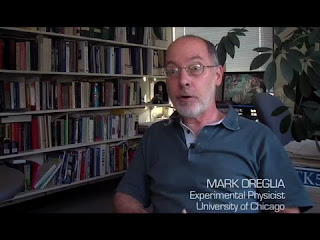


This post is from Mark Oreglia, one of the advisors to "The Atom Smashers".

My colleagues and I loved the film -- not because we were in it, but because of how the filmmakers communicated our arcane subject, and how they were able to focus on the human side of our endeavors. My wife said after the screening "this is the first time I really feel I understand what you do!" So much for my ability to communicate to the public.

The film correctly focusses on competition between various experiments. It is important to understand how important and useful this competition is. Most of the time it is not ugly at all, and it serves to drive us to work harder and produce the best science we can. It also makes sure that results are verified.

I was at CERN last week to attend a workshop on the ATLAS detector, one of the LHC experiments. Two months ago the LHC successfully circulated beams for the first time, so the prospect of bringing the experiments online soon has this place jumping. I was crammed into an office built to comfortably accomodate 4; there were currently 7 people. This is a phenomenon well known to CERN users in the LHC era -- after all, there are nearly 4000 personnel signed on to the 2 main experiments.

Excellent glimpses into life at CERN (at least from the perspective of young people) can be found at here.

Guest post

John Conway writes a guest post. Thanks, John!


When I was first contacted by Clayton and Monica, and invited them out to Fermilab to begin shooting their film, I had in mind at it would be typical science documentary: a sort of voice-of-God "explanation" of our science, what we do, why it's interesting. I could tell on their first visit to Fermilab, though, that they had bigger things in mind. Once I understood what they were after, I tried to hook them up with as many of the people involved in our great quest as I could, people who I hoped would turn out to be interesting on camera.

I have seen the film three times now, and every time I see it I like it better. It really is a unique approach to what could be a very dry and uninteresting topic. (Of course for us physicists it's anything but dry or uninteresting!) The film really captures the spirit of the hunt for the Higgs boson, the excitement and the frustrations. It delves into our lives, our work, and the state of our field.

Hopefully without giving away how the film ends, I can tell you we still have not found any experimental evidence for the Higgs boson. The Tevatron at Fermilab is running amazingly well, we are recording tons of new data every day, and every bit of data brings us a little bit closer to finally seeing the Higgs boson. Next year, the LHC at CERN will start operating for real. It was supposed to have already happened, but in the first two weeks of commissioning, machine suffered a rather serious setback when a string of magnets was damaged by an electrical malfunction. Will this be the break that the Tevatron needed?

Having studied this question for many years now, I think it will still be very hard for the Tevatron experiments to discover the Higgs boson before the LHC, unless the Higgs boson is of the type predicted, for example, by supersymmetry. (That is in fact what I spend my time looking for!) If nature we were that kind, we definitely have a chance to see that at the Tevatron, and as the film shows, we thought we almost had. But hey, you never know...


And what about funding for our field? Happily, we have elected a new president who has promised to try to double the funding for science in the next decade. That would be fantastic except for one quote from the film which keeps coming back to haunt me: it's when Bush's science advisor Jack Marburger intimates that he doesn't foresee funding for high energy physics increasing anytime in the near future. So, it could be that though the rest of science, other fields of physics, enjoy 5-10% increases every year, high-energy physics may not. Time will tell, but I think that we need a major discovery in their field one way or another before our funding levels will increase significantly.

On the home front, as noted at the end of the film, Robin and I (well Robin mostly) had a baby boy in June! Our four month old has made three trips to every lab and one trip to Mexico already, and we are going to Taiwan in December! Yes, his passport photo is very cute. He does take a lot of our time and energy, and we are certain he will be a physicist someday; what other choice could there be?

Tuesday, November 25, 2008

Passing around the hat...

Andrew, our producer, has been hard at work and has put together a great page where you can buy a copy of the film (and, as long as you've got your credit card out, you can donate to our cause to keep the films coming!)

"Can't your budget be diverted?"

We've just gotten a nice write-up in an online publication called "Worldchanging," which operates under the idea that many of the solutions to building a better future are all around us, but just need to be connected. "Informed by that premise," the magazine states, "we do our best to bring you the most important and innovative new tools, models, and ideas for building a bright green future." The writer, Julia Levitt, attended the screening at Vancouver.

The article focuses on one of the issues in the film that appears regularly in our Q & A sessions, and that we expound on in the film at some length: is this worth doing? What's the point of it? Should we care if we find the Higgs boson?

If you haven't seen the film yet, there is a section near the end from a 1979 Donahue show (remember Donahue?) that features Leon Lederman as the guest. Dr. Lederman is featured throughout our film, and is currently nearly as vibrant as he was 30 years ago when he appeared on Donahue. This segment is only a few seconds long, and shows a woman in the crowd standing up to ask a question.


"Hi," she says, "I guess my question is relatively simple. All this money, a hundred million dollars, is that what you said?"

She's referring to an earlier part of the show when Dr. Lederman had mentioned that figure as his lab's budget. There was a visible reaction in the crowd when he stated that figure (remember, this is 1979). Sensing the crowd's unease, he said "does that seem like a lot? Do you know what the military budget is? $100 million buys, I think, one jet airplane." At which point Donahue said "the problem is, you can put the jet airplane in a movie." There's some nervous laughter in the crowd, much of it confused, but Donahue follows up by sharpening the point: "You know what I mean? Then we can all cheer and say 'go, America, and win.'" Then, looking right at Dr. Lederman, he says very directly: "Your work is hard to sell, you know that?"

This point is now being illustrated in no uncertain terms. Donahue quickly answers her question:

"A hundred million. That's just his budget. There are others ---"
"That's just his budget," she says, looking back at Lederman. "Why can't that money be diverted? I feel that cancer research, and other kinds of research are really more important than finding out, you know, just how many quarks make up this world!"

Lederman is watching her with an unreadable expression as she speaks. Behind him is a chalkboard on which he has drawn a rushed diagram of a proton, and finished a (not particularly good) explanation of how a proton is held together. I suspect he is listening to something he has heard a thousand times and has answered hundreds of different ways. Maybe he's thinking he'll never find a way to convince this woman, the audience, or the other people who have expressed similar sentiments, that what he and his colleagues do is worthwhile. Maybe he's thinking that it's not fair to put cancer research and particle physics next to each other on some kind of scale to find out which is more valuable. Or maybe he's thinking it is fair, and doesn't know how to respond. Or maybe he's just tired of talking about it.

in some of the Q&A sessions we've had after the film, the question has come up. So far not in the way that Lederman experienced, but rather from pro-science people wondering how scientists answer this question. We've been asked more than once why we didn't include more information about the ancillary benefits that this type of science generates (after all, CERN invented the world wide web).

The way I respond is to say that our film, while obviously pro-science, is not a science advocacy film. We're not out to prove to you, the viewer, why this kind of science is worth doing. We could trot out a list of all the ways consumer technology or communications technology or even health sciences have benefited from the work people like Dr. Lederman or the other physicists in our film have done. What's far more important, in our minds, is to raise the question. We don't set about answering the question; that's something we feel only the individual viewer can do.

The research that the physicists do in our film as they search for the Higgs boson is called "curiosity-driven" science, or, more simply, pure research. It's knowledge for the sake of understanding. As John Conway says, this is something humans have been doing for 3500 years. That, and that alone, is the way to measure it's worth. And this is exactly where it snags in the fabric of everyday human activity, especially when things seem to be in turmoil. "What good does it do me? Can it cure cancer? Will it make my cell phone better?" To argue that point is, I think, to miss the point. Sure, it might do those things. But more importantly, it has to stand on its own. And many people might find themselves nodding in agreement with the woman from 1979 in the audience of the Donahue show, clearly uninterested in how many quarks make up this world.


In an example of the pleasures I get out of the process of editing, the very next thing you see in the film after the woman from Donahue makes her immanently reasonable statement is Natalie Angier, a science writer from The New York Times. You hear my voice in the background asking "Should we care if the Higgs boson is found?" What follows is one of my favorite moments in the film. Natalie laughs a little, then pauses for a full ten seconds as she tries to figure out how to answer the question. Ten seconds of silence is a long time these days.

Julia's article in Worldchanging addresses this notion. Her first line reads "Is there value in knowledge for the sake of knowledge?" In one of the comments posted at the end of the article, a reader called "sabik" writes

Of course, the problem is how to judge something that won't have a practical application for decades or even centuries. It's a question of what sort of intellectual landscape we are leaving for our children and grand-children - whether it's rich and varied, pregnant with discoveries to be made, or impoverished and bare.

I think this is nicely said. I'll mention something else along these lines that I may have referenced before somewhere in this blog, that addresses head-on the question of the intrinsic worth of "curiosity-driven" science, or pure research. When Robert Wilson (founder of Fermilab) was in congress arguing for the funds that would allow Fermilab to be built, a senator repeatedly asked how Fermilab would contribute to the defense of the country. Finally, exasperated, Wilson said "It will not contribute to the defense of the country. But it will make the country worth defending."

That's Robert Wilson's answer to the question. I wonder if that would have been enough for the woman in the audience?

Hooray!

Just got the word that John Conway, one of the physicists in our film, was just today made a Fellow of the American Physical Society! His citation states he's received this honor "for outstanding contributions in the search for the Higgs boson and physics beyond the Standard Model."

All this on the same day he officially becomes a movie star (OK, a TV star, anyway).

Congratulations, John!

Lotsa press

Monica, my co-director, is originally a playwright. She's had quite a bit of success in the world of theatre. Being a fiction filmmaker myself as well as a documentary filmmaker, I've had plenty of time interacting with actors, many of whom do double duty in the theatrical environment and on the big screen. I learned something interesting about how the role of a theatrical director differs from that of a film director when I saw a play with one of my favorite actors. She pointed out to me something that was clearly going wrong on stage that night: one actor was badly overshadowing another. I whispered something along the lines of "I guess the director is going to have some work to do tonight." She told me, in fact, nope, the director was done. When the curtain rises on opening night, the play, and the actors, are on their own. Hopefully, it's got legs to walk on.

That's a little how Monica, Andrew and I feel about our film. We've set it out there, and it's walking around on its own. We're watching, a little nervously, how it's making its way in the world. We've been gratified to see some positive indications so far: an review on MSNBC says the film "packs a lot of real life into its saga about the world's biggest subatomic quest." A review in Seed magazine says the film "splits open the US's problematic relationship with scientific research... a roller-coaster ride of near breakthroughs, complex research, and dashed hopes." And a review on "Popmatters" does a nice job of communicating many of the themes we were after.

But perhaps my favorite endorsement of the film comes from someone who hasn't seen it yet: a physicist who must have been hearing about it from his peers or reading about it. He even linked to this blog, which was nice. On his own blog, he describes some of the trouble the LHC is having after its major breakdown a couple of month ago. He then wraps up the post by stating

On a more cheerful note, tonight PBS will be broadcasting a documentary about the search for the Higgs at Fermilab called The Atom Smashers. It looks like this program should be about 10^(10^5) times better than a recent one featuring theorists. One of the filmmakers has a blog here. With the LHC out of commission for a while, the Higgs search at the Tevatron is where the action is, and the experimenters there may be the ones to find the Higgs or rule it out.

Now, 10^(10^5) would be 1,000,000, if I'm not mistaken. I've never seen the other film he's referencing, but I certainly can't guarantee that our film is a million times better than that one. But it's nice that a physicist has such high hopes!

[editor's note: I've just been gently corrected. I was, in fact, mistaken, and Mr. Woit of the aforementioned blog is confident that our film is not just a million times better, but rather ... ahem, 10 quadrupa-gazillion times better. In other words, a 10 with one hundred-thousand zeroes after it. The pressure is on!!]

Like the theatre director, though, all I can do at this point is sit back and watch...

(And watch I will --- it's on tonight, Nov. 25, at 10:30 on most PBS stations. But check your local listings.)

Sunday, November 23, 2008

Sharing a microphone and where ideas come from

Monica and I have been lucky enough to attend quite a few screenings of The Atom Smashers, and we've usually been able to stand at the front of the theatre, sharing a microphone, answering questions from the people in the audience after the film ends. It's really fun, actually. For the same reason that proud parents never tire talking about how smart their babies are, we could probably talk forever about our film.

There is a consistency in the questions we're asked, whether in Chicago, Vancouver, or Norway. One of the first to come up is "where did you find this topic?" Often the way the question is asked implies "where in the world did you find this topic?" Or even "what on earth were you thinking?"

It seems to be a predictable pattern: the general public is astonished to find that a) scientists are people not that different from everyone else, and b) that their lives involve exciting stories. It reveals the extent of the disconnect many people seem to have regarding science, and as New York Times science writer Natalie Angier says in our film, it's a disconnect that starts as "early as the fourth grade" and once people get off that track, it's very hard to get back on.

I answer the question by mentioning the newspaper article I read in the Chicago Tribune in 2000 (a link to which I would post here but the Tribune makes you pay for archived articles --- boo) in which science writer Ronald Kotulak beautifully and dramatically set up the scenario that eventually became our film.

It seems a little odd to give so simple an answer: "I read a newspaper article about it" --- but in truth I think that's how the best ideas strike. An idea in one medium presents itself for adaptation into another. When teaching a class at Northwestern to sophomore film students, I discuss where story ideas come from and give another example of just such an adaptive transformation: I remember a day quite clearly in 2003 when I was driving in Kansas City, listening to NPR, and heard a story about how NASA was going to deliberately crash the Galileo space probe into Jupiter so that it would not accidentally hit Europa, one of Jupiter's moons that is potentially harboring life. I nearly crashed my car into a signpost. What a bizarre moment, I thought, and immediately imagined a scene where the scientists sat around a high-energy radio speaker, listening for the last whistling signal before it stuttered to a stop. What would they say to each other? What would they be feeling like?


This time, rather than a documentary, I decided to write a short film script with that little scene at its heart --- not with scientists, but rather with a couple of ... well, science-lovers. I asked Andrew Suprenant, the producer of The Atom Smashers, to produce it, and the script won the Chicago IFP Production fund, which meant we were able to make the film with donated goods and services from cameras to film to editing and the whole shebang. The title? Galileo's Grave. It's nearly done, but got moved to the back burner behind The Atom Smashers.

Maybe it's just that I have a soft spot for where pathos intersects with the scientific method, but I believe the world of science is teeming with great stories. I think that's good news for us at 137 Films, because that's what we focus on.

And yes, when we premiered Galileo's Grave in Chicago, I stood up with Andrew, sharing a microphone, for the Q&A session. The first question? "Where did you get this idea?"

Turkey, Cranberry Sauce, and Blogs

On Thanksgiving four years ago, my dad asked "what's a blog?" At that time I told him it was essentially a diary written by someone for everyone to read. Clearly I didn't really understand the concept. "Who would want to read something like that?" my dad asked. I shrugged.

In my defense, that was largely before blogs became so specialized and so popular, and before I started writing this one.

I had no idea that there were science blogs. Two of them are notable enough that I think I'll add them as the first two blogs to my sidebar. The first is Cosmic Variance, a biggie, to which John Conway (one of our scientists) is a contributor, and which seems to have been absorbed by Discover Magazine. John wrote about our film here and here, and it was in this blog that he posted about the "bump" in the data that caused such a stir in the scientific world and became a major plot point in our film. John is going to make an appearance in the next couple of days as a guest contributor to this blog.

The other blog is Peculiar Velocity, which I'll write about next time...

Thursday, November 20, 2008

TV Party

We're gearing up for the broadcast on Tuesday night! Check your local listings here. It should be on most PBS stations at 10:30pm. We've decided to get together at our friend Caro D'Offay's gallery and watch it on an old-fashioned rabbit-ear TV.

If you haven't visited our PBS website, go check it out...

Thursday, November 6, 2008

BIFF part three: Lutefisk and used car salesmen

I found out the hard way that we had been mis-informed. Our film was actually not in competition. How did I find this out? In one of our nightly dinners I found myself sitting next to one of the documentary competition judges. I was paralyzed between trying to make a nervous joke about our film to see if she reacted enthusiastically and saying nothing in order to maintain a sense of fairness. I said something to the person on the other side of me that I thought it was odd that they would ask the filmmakers and the judges to the same dinner. The person hissed "you should talk to her!"

At film festivals you see a real struggle play out on the faces of nearly everyone around you. You can tell immediately who is a filmmaker because he or she is wearing an anxious expression; a combination of weariness, determination, and desperation. Why is this the case? Because this person, usually a soul-searching obsessive type perfectly happy when wrestling with the larger themes of what makes us human, is suddenly thrust into the role of used car salesman.

All filmmakers at festivals feel the sickening urge that they need to be "doing something" with their film: trying to make a connection, pass off a post-card, drum up attendance, meet a sales rep, get a lead on Australian distribution, meet a programmer for the next festival, find a potential investor. You can see the conflict play out on their faces, and I'm no exception. So, shamefully, when the filmmaker next to me prodded me to talk to the judge, I turned and waited for a pause in the conversation and said something along the lines of

"So, do you see all the films in advance?"
"Yes."
"Oh. I'm Clayton Brown. I'm the co-director of The Atom Smashers."
Pregnant pause as she sipped some wine.
"Oh. Is that here at the festival?"

Needless to say, I was slightly flummoxed.
"Y - yes," I said. "It's a documentary. It's in competition."
"Oh, no, I don't think so," she said firmly. "I would have seen it."

And that was that. She turned back to her wine and I turned back to my reindeer. The filmmaker on the other side of me shrugged.

Interestingly, two days later, this judge became quite friendly to me. I'm not sure why, but at that night's dinner she came right up to me and we hung out the rest of the evening together. She decided in no uncertain terms that I was going to have lutefisk.

What is lutefisk? It's a bit hard to describe. Check out this link for a full explanation, but I'll give you a brief rundown: it's rotting fish that's been soaked in lye.

That's right; lye. After soaking in various solutions of water and lye for over a week, the fish has a jelly-like consistency and is caustic. Only more soaking in water will render it non-poisonous. Doing this step incorrectly will turn the fish into soap. I'm not kidding. Even when done correctly, you can't use your good dinnerware because lutefisk will permanently ruin silver.

It's served with a couple of potatoes and a small pot of bacon. You dribble the bacon over the jelly-like fish which gives it some semblance of flavor.

Interestingly, some of the younger Norwegians at our table had never had lutefisk and stubbornly refused to even try it (I should have taken this as a warning. Actually I did, but the judge with me would have none of it. She ordered for me, and the waitress had an odd expression upon leaving. I asked about this and the judge told me that she had indicated exactly what sequence everything should arrive in. "I think she thinks I'm bossy," she said. "I think you're bossy," I told her.) They said "this fish is poison. It's made of caustic chemicals. It has lye. It's not meant for human consumption!"

So, I'll be honest, it was not my favorite. I was grateful for the bacon, at least, and the plain potato. At least I earned the respect of the judge.

In some ways I was not as disappointed as I thought I would be when I found we weren't in competition. It took a little of the pressure off. This is perhaps why I enjoyed the second screening of the film much more. It wasn't quite sold out, but the crowd was much livelier. Earlier in the week I had had a couple of conversations with other filmmakers, including Pietra Bretkelly, who had a great film at the festival called The Art Star and the Sudanese Twins. She was talking after one of her screenings and said "I think I shocked the audience with my film. No one said a word at the Q&A afterwards." Turns out many of us had the same experience, and when we asked the festival organizers, they said "oh, yeah. Norwegians are shy. It takes them a while to ask questions."

But luckily, the shy Norwegians had apparently gotten up their collective nerve because there was a lengthy and spirited Q&A session after the second screening.

Oh, one more thing: after eating the Lutefisk, one of the other filmmakers came around and said "hey, I heard you were looking for European distribution. There are a couple of sales reps over there at the next table." So I had to put on my used-car salesman face and head over there. Turns out one of them was interested in the film, and after I got back to the states said she wanted another copy...

BIFF part two: Lidenskapen, Reindeer, and James Caan

Apologies for the delay!

So, as promised: first, a report on the screenings. The first one was sold out, which was a real surprise. A pleasant surprise, to be sure, but somehow unexpected. A sold out screening in Vancouver is one thing, being neighbors with the US. But Norway? I think it pays tribute to our poster image, the nice blurb in the festival program, and, frankly, the Obama-fascination that is apparently all around the world. However, I would also like to think that it means we've got a good film on our hands.

Interestingly, after the film, there was hardly a Q&A at all. The full-house crowd sat, quiet as a mouse, with only one or two questions being asked. Afterwards one of the (incredibly nice) festival staff who was leading the session sheepishly apologized and said next time hopefully there would be some better questions.


While the film was screening, I was actually doing a panel discussion with two other documentary filmmakers for the BIFF TV website. I think most of what I said ended up on the cutting room floor. (There could be a long post here about what it's like to be on the other side of the camera, being asked questions, what it's like to wonder if what you're saying is interesting, but... maybe another time). By the way, "Lidenskapen" means "passion."

So, on to the other part of what I promised next time: an interesting dinner companion.

When your film gets accepted to a (larger) festival, there's a chance they'll fly you out, put you up at a nice hotel, and take you out to dinner every night. Boy, it's nice. I'd recommend you all start making films in order to experience this part of it. It's a little bit of payback for the 40,000 hours spent lugging equipment, pulling your hair out wondering if you've got a story, and working the kinks out of your mouse-clicking arm. Anyway, the second night, I found myself eating Reindeer again, sitting next to a man with a rather loud, low, gravelly voice. He seemed a little tipsy. He was telling stories in English, Norwegian, and a couple of other languages. I was talking to some other people at the table and hadn't really listened too much, especially since I couldn't understand most of it.

It came up that I was a teacher of film production, and so we started talking about films (what a surprise). Somehow the notion of the Dogme 95 movement came up, and how one of the leaders of that group (Thomas Vinterberg) had a new film that was here at the festival. I said that even though I thought some of the ideas behind it were great, there was really only one of those films that I liked, which was The Celebration. The guy I was talking to reminded me that Vinterberg was the director, and his film was here. He also casually pointed at the guy next to me, the one telling stories in Norwegian, and said. "He was in The Celebration." I blinked. "Really?" "Yeah. Remember the loudmouth brother? That was him." His name is Thomas Bo Larsen and we ended up having a really great conversation about acting and directing, especially after he told me that the best piece of directing he ever got was when Vintenberg told him during the shooting of The Celebration that "in this film, you are playing the role of James Caan in The Godfather." Really, what actor wouldn't nod and say "Ahh. Got it."? It was fun talking about good directing (short, loaded suggestions) and bad directing (long-winded explorations of minutiae), and what actors like and don't like (being part of, and excluded from, the creative process, respectively). At the end of the evening, he volunteered that he would fly himself to Northwestern to talk to my classes. I think he was a little drunk, but I believe he meant it at the time.

Friday, October 17, 2008

BIFF


I'm in Bergen, Norway, at the Bergen International Film Festival... I just got back from the first screening, which wasn't part of the festival, but rather an additional screening the festival organized at a nearby science center. The audience was composed of about 60 high school students and a few teachers. There was a Q&A afterwards, which went pretty well. Last night I had dinner with the director of the festival at a traditional Norwegian restaurant, where I had filet of reindeer.

Next time I'll fill you in more on a fascinating conversation I had with an unexpected dinner companion, as well as on the first festival screening...

How audacious

We've won a prize!!

In the Pariscience festival, we picked up the "Audacity Award." This appears to be the second prize of the festival, and is described as awarded awarded "for a film that’s shows originality in its subject matter or treatment." It includes a nice cash component as well! One of our intrepid physicists, Gregorio Bernardi (who appears twice in the film: he is one of the explainers of the Higgs boson as well as the guy who describes what I call "the magic screen," referred to in an earlier post) actually teaches at the University of Paris, and was able to attend the awards ceremony.


He said that it was like "a mini-Oscars ceremony," where a clip from each prize-winning film was shown. He said the clip they showed from our film was from the animated section of the explanation of how the Tevatron works, with Luke Haddock's great animations and Dr. Lederman's voiceover. Apparently there was even a plaque awarded, which Gregorio kindly accepted on our behalf. Whenever we get an office, that will be one of the first things that goes up on the wall.

So now we can officially add "Award-winning" to our descriptions...

Tuesday, October 7, 2008

Vancouver News Part 2

The second screening went quite well also --- not sold out, but nearly everyone stayed for another lively Q&A. Hosting the session was the festival director, which was quite a treat. The film shows a third time at the festival on Wednesday 10/10, but alas, none of us will be there.

In the meantime, a good friend of mine posted a blog entry about my blog entry, so I'm tying us up in knots further by blogging about his entry about my entry. He's an old friend from college and has made a name for himself as a voiceover talent / NPR dj. He's got a great blog about music (specifically jazz) with great musings about recording, musical personalities, and how music holds up and changes over time. He was interested to read about my musings on music in film, and specifically my experience working with Kate Simko, the composer for The Atom Smashers.

More interest: today and yesterday we received our first inquiries from down under, specifically from the Australian Centre for the Moving Image as well as a film festival in Perth. If we only had a nice, fat, travel budget...

Now we're gearing up for the Austin Film Festival, where we have a nice page here, as well as the Bergen Festival in Norway, with a page here.

Sunday, October 5, 2008

Vancouver news (part 1)

Briefly, a picture of something every filmmaker would love to see: "Sold Out!" The first screening went beautifully, with a sold out crowd of about 250. Almost everyone stayed for a good Q&A afterwards. On my way now to the second screening, on a Sunday morning at 10:45. I'm guessing there won't be a "sold out" sign for this one...

Tuesday, September 30, 2008

What a Triumf

Found out that TRIUMF, a Canadian subatomic research laboratory, has decided to sponsor our film at the Vancouver Film Festival! I don't really know what this means, but they have a blurb about the film on their website! Thank you, TRIUMF!

Ahora puedo hablar espanol

It's fun to stumble across your work on the web somewhere. On this blog I have a thing called "statcounter" which tells me more or less how many people visit every day. I can even find out how they navigated to my blog. Turns out 95% of people end up on my blog from Wikipedia. People do a search for "Higgs" or "Higgs boson" or "Peter Higgs." At the bottom of the page is a tiny little link that says "An interview with Peter Higgs." It goes to my page. Not sure how it got there, but several people every day click on that link and end up in my blog. I imagine most of them click away almost immediately.

But another link caught my eye. A single, solitary person found my blog from another blog called "Astronomia." I clicked on the link, and lo and behold, found a very long blog entry dedicated to the film, complete with pictures, a write-up, some thoughts, and a collection of links. They even explain the origin of our company name, 137 Films, with a picture of our logo, and a brief bio on Monica and me.

All in Spanish.

You've read about Marcela Carena in my blog in previous posts: the Argentinian theoretical physicist (and tango dancer). I think perhaps she passed on some information to them. There is a brief interview with her.

How do I know this? Do I speak Spanish? Alas, no. However, Google is an amazing thing. Click a "translate this page" button, and presto!

My favorite translation is that Leon Lederman's (infamous) nick-name for the Higgs boson, the god particle, comes out as "The Particle of God." So much more dramatic. Overall, though, the translation seems to be excellent, aside from a consistent confusion of gender of the third person pronoun (both Marcela and the film itself are referred to as "him"). I'm very impressed with Google. Maybe I'm just happy to see someone writing about our film in another language.

Sunday, September 21, 2008

Keeping Score

Kate Simko, a local composer/electronic music artist with a pretty good national and international reputation, scored the music for our film. She just forwarded a link to a blog where she wrote about the process of composing the score for the film (Kate was a contributor to the blog; the blog as a whole is about the process of creating and listening to music).

It was really fun for me especially to read her entry. Andrew and I first met with Kate some years ago, as we were just getting started with the film. It was so early in the process that we didn't really have much to say about what we thought it would be like, so Kate listened to us and expressed her interest, and then we went our separate ways for about two years.

In the meantime, I fell into a trap that happens to many editors. (Monica fell into it, too). I fell in love with my temp tracks. This is a common phenomenon, and here's how it works: you have passed a critical phase in the edit. You've moved past "what should be in? What should be left out?" and are beginning to work on shaping, feel, tone, mood, rhythm. The fun part. You're no longer scouring transcriptions to find what quotes to use, you're so familiar with the "b-roll" (shots of buildings, landscapes, people walking, transition shots, or anything else that's beautiful or interesting that can be used to cover up awkward cuts, or shots that can take on metaphoric meaning when placed in context. Hmmm... I think I'll write a new entry in homage to the b-roll. Watch for that...) that you can draw from it at will, and you're constructing sections, conversations, phrases, moments. It's the real fun part.

So, naturally, one of the first things you do is to add music. Anyone who's ever edited (or even listened to This American Life, for that matter, knows the effect that the appearance of music can have on your material. Here's what Ira Glass himself said about it in a 1998 online article:

People ask, "Why do you put so much music?" It's because music is like basil. Everything's going to go better. Put it on, don't think twice. Chicken, vegetables — it's just going to be better.

Now, that was before This American Life was criticized for using music as liberally as, well, basil. They've since become a bit more careful about it. When I teach sound design at Northwestern, I often quote from the great film post-production intellectual Walter Murch, who lamented that many times editors used music to install or imbue a scene with emotion, rather than reflect and direct the emotion that (hopefully) is already there. In short, music often tells the viewer / listener "this is a sad moment. Hear the sad music? You should be feeling sad now." (This is how This American Life was criticized for its use of music: too often it served to tell the listener what to feel).

When done right, Murch claims, music simply unlocks or directs the powerful emotions that are already there. When that happens, it becomes a moment that is greater than the sum of its parts: the emotion in the scene and the music that appears catapults the experience beyond the left-brain understanding of what is being said and seen; the right-brain gets involved and the whole thing becomes magic.

So --- back to the temp music. Monica and I had discussed the music at length. The Tevatron (Fermilab's 40-year old particle accelerator) was a beautiful, ugly, advanced and primitive machine with percolating valves, hi-tech computers, rusting bolts, dirty concrete, gleaming surfaces, and a devious personality. What's more, it was located smack in the middle of a prairie, with native grasses and buffalo wandering around. We knew that somehow we needed music to reflect this crazy combination of unfathomable technology and raw nature. A tall order. Andrew, our producer, had introduced me to Jan Jelinek's music. It seemed to capture what we were looking for perfectly. It was electronic music, yes, but generated from dirty analogue sources. We fell in love with it, and I used it almost exclusively.

So much so, in fact, that I had a hard time trying to part with it. So, Andrew said, "well, why not ask if we can use it?" Being the producer that he is, he tracked down Jelinek's agent and inquired. Sure, we were told. We could use the music. As long as we licensed it.

At $120 per second.

Per second.

I did a quick tally. I had approximately 20 minutes of music in the cut. A cozy $144,000.

Suddenly parting with Jelinek's music was much easier.

Re-enter Kate Simko. We had gotten back in touch. She was ready and excited to begin working; it fell neatly between projects for her so she had the time. I screwed up my courage to tell her that I was really attached to the Jelinek music; most composers hate to hear that editors have fallen in love with temp music. It means they might be expected to try to mimic what's already there. With Kate, I felt instantly relieved. She said, "I love Jan Jelenik!"

She also stated in no uncertain terms that she was not going to be doing any mimicry. She had to have free rein to compose, not just replace. But having the temp music already there was, for her, a good starting point: it meant she didn't have to try to pick a director's brain about some of the basics of timing, mood shifts, rises and falls, etc.

Then the fun part began. Kate and I had many long conversations where we watched parts of the film and I got to expound on the emotional texture of the film. She asked me to just describe what the "feel" of the film was at a certain point, and she took copious notes. I'll quote here from the blog entry I referenced above:

Clayton and I went through the scenes in the film together and he provided poignant adjectives to describe the mood in each scene. For example, one of my favorite compositions, which we called "Tevatron Dream," was described by Clayton as, "the tevetron having a dream. slightly surreal; waiting, peaceful intermission; rye sense of humor, dreamy, wink in eye, half asleep, kicking back, relaxing after hard work; not dark, emotionally neutral." After understanding the underlying mood in each scene, I started collecting timbres, textures, and modeling synths that I thought might fit.

That phrase, "The Tevatron having a dream," was something that I came back to again and again. I thought it was an absolutely perfect way to describe the passage. If the tevatron could have a dream, what would it dream about? As this aging machine, contemplating the last years of its life, drifted off to slumber, what images would rumble around its four-mile ring? I suspect the Higgs boson would be part of it. I could imagine the Tevatron twitching as it slept, like a dog, its legs gently pawing at an imaginary lawn. The Tevatron might bump and rattle a little as it slept, drifting through the ether and racing across the universe, dragging through the Higgs field, bouncing between protons and electrons, sighing gently as it settled down next to the buffalo, then jumping up again as an anti-proton exploded into a shower of gluons and tau pairs.

I think Kate got it perfectly. It's an example of the incredible processes involved in creativity: taking a semi-incoherent series of descriptions (mine) through intense technology (Kate's synthesizers and computers) and emerging with something beautiful. (Trying to figure out how to post audio here; anyone know how to do it? Kate has an example on her blog of another cut from the film).

Over the course of several weeks, we posted files back and forth, and Kate was extraordinarily cooperative, going above and beyond the call by letting me sit with her and listen to the cuts in progress, patiently letting me say things like "it should be a little darker here" or "a bit too rhythmic --- can you pull back the beats?" I think it helped that I have a background in music, so I was able to talk to her about major and minor keys, tempo, tonality, and the like.

I'll wrap it up here by saying that Kate was extraordinary to work with. We ended up with something that exceeded what the temp track had done, because it was custom-fitted for the film. Rather than being a piece of music that was composed in Scandinavia and simply placed into a soundtrack, Kate's score was composed to match the characters and stories in the film. It rose and fell at the right moments, reflected the environment, and was guided by what was happening. It didn't install emotion into the scenes, but rather reflected what was already there.

I think Walter Murch would have approved.

Friday, September 19, 2008

Black and white and read all over

A brief interview with Monica and me in the Chicago Tribune in advance of our big show tonight at the Museum of Science and Industry...

Tuesday, September 9, 2008

Speaking of competition...

We've found out that we're one of 14 documentaries in competition at the Vancouver Film Festival! 100 docs have been accepted, but only 14 are in competition. They even gave us a nice splash page --- in fact, I think the write up they gave us is about the best synopsis yet! We're showing three times there.

Also, we found out we've been accepted into the Austin Film Festival! Our drought of domestic festivals is finally over. We're in competition there, as well as in Paris. Keep your fingers crossed...

"I call it a competitive collaboration"

So, let's face it. CERN has stolen the show.

We all knew this was going to happen. The good old Tevatron (the accelerator at Fermilab) must be feeling a little neglected right about now. In our film, Ben Kilminster gives us an occasional countdown ("643 days until CERN starts up..." "422 days until CERN starts up"). For, as you will see when you finally get to see The Atom Smashers, Fermilab is in a race against CERN to find the Higgs boson.

And today, Wednesday, the time has come. CERN is starting up.

Rather than lament the passing of the torch, I'll join in celebrating the moment with the other gazillion physicists salivating for this behemoth to open its eyes and look around. In fact, many of the physicists at Fermilab are nearly as excited. Many of them are, in fact, going to ramp up working at CERN, making fewer visits to Fermilab. But, again, I'm not mourning. As Leon Lederman said, the relationship between the two labs is a competitive collaboration. Many results will be shared. So, I'm not going to rehash what this blog has explored in depth: the troubling future for this kind of science in the U.S.

I'll be excited, too. Because, let me tell you, physicists are ecstatic about this thing. How do I know? You can find out by watching this. You absolutely must, must, must watch it. There, I just watched it again. Who knew physicists could rap?

If we were still shooting our film, we'd certainly have the camera rolling at Fermilab, where they will be having, and I kid you not, a pajama party to watch the events live from a remote control room.

So let's all give CERN its due and celebrate this amazing technological marvel. It'll take a few months to get really rolling: this is just a baby step. But what a step...

Wednesday, August 27, 2008

We're feeling accepted

More acceptances are coming in: we've been accepted to a science film festival in Paris called Pariscience, to one in Bergen, Norway, (our image on that link!) and we're waiting to hear from a big one called IDFA in The Netherlands. With the one in Milan from a couple of months ago and the one we're attending in Vancouver, it's striking us as a little ironic that we've been accepted to four, possibly five festivals outside the US but not one in our own country! Chances were looking good for the Chicago International Film Festival, but our screening at the Museum of Science and Industry makes us ineligible for that one.

We're getting a little press, too: recently we were interviewed for The Miller-McCune Center for Research, Media, and Public Policy magazine and Fermilab's magazine. Will post those when they come up. Hopefully more will follow... In the meantime John Conway did a blog entry about the film in the widely-read science blog, Cosmic Variance. Thanks, John!

At the museum

So, we've wrangled an exciting local event: we'll be screening the film at the Museum of Science and Industry as the kickoff to Science Chicago, on Friday, Sept. 19 at 7pm and again on Saturday the 20th in the afternoon (time TBD). The fun part is that we'll have a panel discussion afterwards with us, possibly a museum person, and several scientists from the film: Marcela Carena, John Conway, Robin Erbacher, Ben Kilminster, and Mark Oreglia! That should be really fun. If you're in Chicago, you should definitely be there!

Wednesday, July 23, 2008

Acceptance!

Yee ha! We just found out we've been accepted to the Vancouver International Film Festival! It's our first big festival, so it will be the official world premiere. I'm going to try to go --- all three of us would like to, but it comes down to travel money. We'll see. Our primary mission there? Try for Canadian TV distribution...

Sunday, July 20, 2008

Deliverance!

We made it --- the video tape master is in the hands of PBS, having reached them on the appointed day at the appointed hour. The last two weeks actually got pretty hairy. We were actually ahead of schedule, with our sound mixer and the composer humming along, doing their tweaks, and with only a day's worth of color correction needed before the thing was done. I was about to head out of town for two weeks on an extended camping trip (I know; smacks of hubris) when the hard drive gods decided I had had it too easy for too long. I flipped on my computer, coffee in hand, to check my email, when I saw the following message:


You may be surprised to know that I didn't panic. Truth is, when you have ten (TEN!) external hard drives like I do, occasionally one of them will get momentarily confused. All that is needed is a simple restart and the problem goes away. However, this time, the error message popped up again. That's when I started to get a little worried. I tried again, and, yep, the message appeared for the third time. I looked at the faithful drives that DID appear, and by process of elimination I saw that 137 Films VOL 3 was missing in action. I started trying to remember what was on VOL 3. That's when I really started to sweat.

First of all, and most important, all the edit files were on there. It's the equivalent of, say, if I were writing a novel, the manuscript was on that drive. Yes, that's right. The film itself. Of course, I would be a fool if I hadn't made several dozen backup copies in several dozen different places, so I wasn't too worried about that.

What was more troubling was that all the color-corrected video files were on VOL 3. These were many, many gigabytes, and without having twenty external hard drives, it's just not possible to back up the video files. All the work that Tyler, our color-corrector, had done. Without getting too technical, not only would this have meant the loss of all his work, but it would have incurred dozens of hours of work on my part, tediously re-linking non-color corrected video files and then re-color correcting everything.

I tried all my usual tricks and repair software, but nothing worked. I sent out email and phone calls, asking help, and searched the internet for suggestions. I even called one of those hard drive recovery places, but their quotes were nearly more than the entire budget of our film. Finally, Andy Swindler, one of our board members, emailed to recommend Data Rescue II, some software I had never heard of. Plus, it was only $100! To make a long story short, Data Rescue II cooked along for 12 hours, and made a nearly 100% recovery of all the files. Phew. I didn't even tell Monica, my co-director, so if she ever reads this blog, it will be the first she's heard of it.

Anyway, many gray hairs and several stomach aches later, the sound files came in, and the file went out to the lab where they transfered our film to digi-beta according to all the detailed technical specs PBS provided. After a stop-start hiccup from PBS involving credit approval (they have to approve all the credits down to the period: they have many rules about funders not appearing in the "thank you" section, that a person and the person's company cannot both be thanked, that only funders at a certain level can appear in the credits, there can be no duplications in the front and end credits, no company logos may appear (including our own), etc.) we got the go ahead and the tape was made and sent off to San Francisco. Even got a little thank you email from our contact for being on time.

Then I went on my camping trip.

Friday, June 20, 2008

Deliverables

Some of the things PBS wants from us:
1. a "Face of the Program" image. Meaning, a portrait of whomever is going to appear as "the filmmaker." Naturally, we wanted a group portrait of the three of us.

So we went down to Fermilab again (it had been a while) and arranged with their media/PR guy to allow us into various places around the complex. The most photogenic place by far (and one that all media people seem to gravitate towards) is the Flash-Gordon/James Bond inspired "Cockroft-Walton." We took a few down below on the floor, but none of us was happy with those, so we got up on the lift and rode to the top of the machine where we took some more. By this time we had loosened up a little. We took a couple of good ones.

That was a problem, unfortunately --- we had two good ones. We arrived at an impasse. Monica and I liked one, Andrew liked the other. What do you do? We argued back and forth, but ultimately sent both of them to PBS to let them choose. (I graciously won't tell you whose favorite they picked)

So, behold, our "Face of the Program:"


Next up:
2. A "Signature Image." This is whatever image we want to appear on the DVD, in ads, press, posters, postcards, etc. Not sure how much of that they'll be doing (probably no posters or even postcards). When we went to New York for the IFP market we printed up a batch of postcards and even a poster, which is now framed in my office at Northwestern. Andrew, being quite a skilled photographer, took a batch of photos in and around Fermilab last summer. Once again, we debated which ones we liked, went back and forth, and finally agreed on a picture of Marcela Carena at her chalkboard, with a mind-numbing array of equations. She agreed to "work" for us in front of the camera, writing equations. It was pretty fascinating: it very much resembled a writer (or even a poet) standing there, thinking, then writing, then erasing, then mumbling, writing a few more equations, mumbling some more, and changing things around. It would be interesting to hook up an MRI to Marcela and one to a writer as they wrote a short story out to see if the same brain centers lit up.

Anyway, we all agreed on this picture as our "signature image." We still like it. Many people (especially women) have commented on the buff biceps Marcela is sporting on her chalk-drawing arm.

Here you go, then, our "Signature Image," complete with some text in the postcard layout:


Finally, I'll post the runner up to our signature image. We all loved this picture as well, but decided that we preferred to have a person on our image, since our story is so much about the people in pursuit of this scientific breakthrough. This, in fact, is the same Cockroft-Walton from below, looking very much as if it could just pick up and start walking, blasting away with some photon torpedoes...


So why does PBS want all of this? They have plans to promote the show, of course, which makes us all giddy inside. More on that next time!

Thursday, June 19, 2008

Cracking the whip

The folks at PBS are serious. Even though our show won't air until November, they wanted our final edit by ... July 3. Ahem. Cutting down our movie from 81 minutes to 53:30 is nothing to be sneezed at, so we asked for a couple more weeks, and they said "one would be better, but if you need two, then go ahead." Here's another advantage of having a co-director: I had been editing for hours and tried to write an email asking for a later delivery date. I re-read it just before I pressed "send," and thought, "I think this might sound a little whiney." So I sent it to Monica, my co-director, instead. She had a more fresh perspective, re-wrote it, and sent it out. Normally I'm a little more tactful, but 15 hours in front of a computer monitor will do that to you.

Surprisingly, the 26 minutes were much, much easier to excise than we thought they'd be. One of the producers at PBS, Lois Vossen, gave us some very shrewd cut-down notes with recommendations on what she thought should stay and what should hit the cutting room floor. We followed many of her suggestions, as we had come at some similar conclusions ourselves, but we differed on a few things. A wonderful thing about Independent Lens on PBS is that key first word: "Independent." Lois made it very clear from the onset that I.L. was a showcase for independent filmmakers, and while she would give suggestions and feedback, ultimately the editing decisions would be ours. For a small filmmaking group airing nationally for the first time, that is hugely important and a vote of confidence from PBS that we appreciate tremendously.

So, we've almost got the 53:30 cut in place. To get it to this point we've taken the equivalent of a meat cleaver to it, and now must get the scalpel back out for delicate fine-tuning before we're satisfied. With a giant revision such as this, it's easy to lose track of your subtle transitions, breathing room, and moments for reflection. The danger becomes that the piece is hacked and rearranged to the point that it feels breathless and rushed, clumsy and lurching. That's the point where we are now, evaluating for "feel" and "pacing" and "rhythm" and all those other esoteric descriptors. (I've heard that musicians make the best editors, and I believe it. Of course, being a musician myself makes me a little biased) and I'm glad to say we've gotten to this stage a couple of days earlier than I anticipated. By end of day tomorrow, I hope to have the final cut polished and gleaming, ready for the next stage.

More on that next time...

Thanks to all who wrote in with congratulations!

Sunday, June 8, 2008

Ta Daaa!!

At long last, I can post the news I've been hoping for ... The Atom Smashers has been acquired by PBS!

We're going to be on Independent Lens!!

Not sure how to make that text as big as it should be since I'm practically shouting it.

Let me tell you how this all came about. Remember back in September of last year? We attended the IFP Market in New York. At the time, Independent Lens requested a meeting with us. They were one of seven or so distributors who asked to meet with us to discuss the film. At that time, we thought we were about done with the edit. We spoke to Kathryn Lo, who was extremely friendly and encouraging. She didn't commit to anything at the time, but asked us to keep in touch.

We returned from NYC excited about the whole experience and ready to launch our film. Then, we entered the "waiting zone" that so many films encounter. We entered several film festivals but weren't accepted by any of them. We had many nibbles from different distributors across the country, both big and small, but we couldn't seem to close the deal. Meanwhile, our edit went from 97 minutes down to 88, then 85. We had quite a bit of feedback and tightened the cut, making it leaner, meaner, and more succinct.

At another IFP event in Chicago, the interest started to pick up again. P.O.V., another show on PBS, saw a 7-minute trailer and requested a dvd. Nova asked for a copy. Film festivals in Europe began asking us to enter. Netflix re-affirmed their interest. The World Science Festival in New York heard that we had made a documentary with Leon Lederman and asked for clips. The Science Channel was interested. We knew we had a good film on our hands --- but we just couldn't land a deal.

Each time we had a new edit I sent a copy to Independent Lens and followed up with an email and a phone call. Finally, in April, Kathryn Lo indicated they would make a decision on a certain Friday about whether to air our film. She asked at that time if we would be opposed to cutting it down to an hour. I told her we'd prefer to keep it at the current length of 81 minutes, but that we'd go for the 53:30 cut if they did indeed want to air it. The Friday came. We were on pins and needles. It was a cold April day and I went to the Garfield Park Conservatory here in Chicago to walk around tropical plants and breathe in some warm, moist air to keep my nerves in check. Finally, Kathryn Lo called. The verdict ... they ... said... maybe! They couldn't decide! They were going to put off the decision for another month. Agonizing. The issue was they weren't sure if the film could survive the drastic cut from 85 minutes to 53. Kathryn said she wasn't sure if the film would retain its "charm" if we had to take such a chainsaw to it.

So, we waited again. In the meantime, Andrew, our producer, watched the film with some friends, and came to Monica and I with a list of suggestions. We took another long look at our baby and realized there were still some problems with the story. We got out the scalpel again, sliced and diced, and stitched it back up again. We ended up with the tightest and best edit yet, and once again I sent it off to PBS with an email and a phone call.

Finally, last week, we got the good news! We'll be broadcast sometime in November, and have been told that our film will be seen by 1.5 million viewers.

Ulp. 1.5 million viewers.

Anyway, now that we have emerged from the endless circling pattern, I'll have something to write about again. The film will be moving into broadcast and we, as a young company, will be moving into our first film's premiere. I'll begin posting again and will let you know how all this works. We're going to be drinking lots of coffee around here...

Thanks for reading, and I hope you'll check in regularly for the next phase of this long story!

Yours,

Clayton

Friday, February 15, 2008

Been a long time...

Yes, it has been a while since my last post! Sorry about the lapse.

Things have been very busy around here at 137 Films central. We're still discussing potential outlets for our film, including some TV and cable opportunities, and we wait for film festivals to give us the thumbs up or thumbs down (more downs than ups lately, although we've been accepted to a festival in Milan (!) (our budget is not going to allow us to go, unfortunately). Currently I'm waiting to hear from a few outlets and a certain publicly funded television network that shall remain nameless for now because I'm superstitious.

Anyway, I will write a more substantive post soon --- suffice it to say even though I've been absent, I haven't been idle!

more to come

Tuesday, December 18, 2007

Test Screening

A nail-biter --- you're showing the completed film to a room full of strangers for the first time. They're not your friends or your family, they've never heard of you or the film, most of them have never heard of Fermilab and none of them has ever heard of the Higgs boson. Will they like it?

The answer, as we found out a couple of weeks ago at a small theatre in Chicago at a test screening organized by the Chicago branch of the IFP, was yes! We were quite relieved. There was a question and answer session afterwards, and there was a lively discussion about the film that lasted about 20 minutes. Overall, it was very gratifying.

Well, I should be honest. The answer was yes, they liked it ... mostly. We heard some excellent feedback.

At the stage where we're at (nearly complete) there is feedback you like to get, and feedback you dread. The feedback you dread is the kind that sounds like "hmmm..... I didn't really understand it. What were they doing?" or worse, "so, what was going on?". The worst of all, though, is just a room full of bored people who don't even have a question. It just didn't work, they weren't interested, and they were just ready to leave. That's the kind of screening directors have nightmares about.

The good kind of feedback is, happily, the kind we got. People are truly engaged by the film --- they're asking question after question about the content ("did they see the budget cut coming?" "when are they all going to make the move to CERN?"), which means they were hooked by the story and the characters. And their critiques about the film itself are specific and small: "I saw that one shot of that piece of equipment twice" or "I think you could cut out that part about Intelligent Design. We got it, and that was a little repetitive." Those are clear, easy things to do, and by and large we agreed with every one of them. Altogether, they gave us smart, concise suggestions that could help us shave off nearly 8 or even 9 minutes of the film, which would bring us from a (slightly) big 97 minutes to a (perfect) 88 minutes.

We've set early January as the date for the final FINAL cut, reflecting these last changes...

Monday, December 10, 2007

The latest

So, it's been a while! Apologies for such a long delay in writing.

We've been working hard in two areas: first, the post-production. We have enlisted the services of Kate Simko as our composer, and she and I have had many hours of meetings to discuss the soundtrack, which she is composing for our film. She's an electronic/ambient composer, and you can check out her work here. We've wrapped it up and I'm feeling really good about the work she's done.

I've also been spending a lot of time in the studios of Mosaic Music where Rich Rankin has been doing the sound mix. He's done wonders with balancing the EQ, making sure the room tones sound the same, and making sure the music doesn't drown out the voices and vice versa. Such a pleasure not to have to do that myself.

And I've been working closely with Tyler Roth who has been doing the color correction to the film --- making things look as good as they can. Makes a huge difference.

Second, we've been working hard on the long list of contacts and potential relationships with groups we made while at the IFP Market in New York. Several people requested copies of the film, so we sent out quite a few in the two weeks that followed the Market. We got a few more requests after that. We made one round of follow-up calls, to remind them and encourage them to watch it (of course they hadn't yet). I've just finished making a second round of calls. I was encouraged --- this time they had all watched it and there were some expressions of real interest (knock on wood). Everything is going to grind to a halt at this time of the year so we'll pick things back up in early January.

We also have some legal things to do: we have quite a few people on tape that appear in the backgrounds of shots, or for just a few seconds, that we don't have signed releases for. We're in the process of talking to lawyers, etc. to decide how aggressively we need to pursue their signatures.

So, it's a different kind of work than the creative kind. But it's still fun, because now we have a (nearly) completed piece that we're working with --- it's always nice to be able to hold something in your hands rather than just discussing it in the abstract.

Monday, October 1, 2007

And In Other News...

The New York Times is not the only paper to document the difficulties scientists have in communicating with Washington DC. Scientists Ask Congress to Fund $50 Billion Science Thing.

But even worse is the news that the Super Monkey Collider Loses Funding.

We can be comforted, though, by the reassuring report that maybe we've been wrong about the Bush administration all along. After all, Bush Finds Error in Fermilab Calculations.

At last...

Our movie is done!

Or, maybe:

OUR MOVIE IS DONE!!!

Holy cow.

A little clarification: our part is done. The edit is done. The movie exists, we love it, and we are extremely proud of it.

Now we turn it over to Kate Simko, our composer, to finish scoring the music, and Rich Rankin, our sound designer, to clean up all the sound, and Tyler Roth, our colorist, to make all the scenes match and make sure everything looks as good as it can. And Luke Haddock, our visual effects artist, is still working on some of the graphics. We have lo-resolution versions in there now, but he will soon give us the full-res graphics that we can then drop in place.

Now: I burn about 10-15 dvds for immediate mailing to some of the contacts I mentioned earlier and wait for our post-production team to finish up on their end.

Oh, yeah --- and send out another round of "can you help us?" fund-raising letters. Some of you might see some in the mail soon...

It's hard to believe I'm actually writing these words! It's been over three years...

More updates as they happen... but for now, I'm still trying to let it sink in.

Friday, September 28, 2007

Day Five

At long last, with apologies, I will complete the week at the IFP...

Our last day started well. We had a meeting with PBS, and again we were met with positive thoughts and comments about our film. Not surprisingly, we were told that NOVA would probably be a good fit for us, and were told that NOVA "had gone through some changes" and would be interested in a piece like ours. I raised the fact that we were all fans of NOVA, but had always assumed our film was not such a good fit, since ours is less a science documentary (one that sets out primarily to teach the viewers about science) and much more a story taking place in the realm of science. Our contact person indicated this would fit fine in the NOVA model.

She also asked if we'd be interested in being considered for Independent Lens, which we were very interested in, thank you. As before, she expressed a real desire to see a "full cut of the film whenever it's ready." It was a great meeting, and a little head-spinning that we were chatting with PBS about how our film could be a good fit for public television. She even indicated that a previous theatrical run would be just fine as far as they were concerned.

Our next meeting was one that was assigned to us during the week --- in other words, someone came across our project late and requested a meeting. It may have had something to do with mailings and phone calls we made, but whatever the reason, we found ourselves in a meeting with a very high-powered film sales company. Previous films include "Born into Brothels" (last year's Oscar winner), Crazy Love, Fahrenheit 9-11, My Architect, etc. Pretty big-hitters. What do they do? You might check into one of my previous posts about Film Reps and Sales Reps, but essentially they become a cross between your agent, your carnival barker, your palm-greaser, your used-car salesman, and your deal-maker. They get you into all the good festivals. They get everybody interested in your film. In his words, "we create a bidding war for your film." This group is among the best with an excellent track record, and you have to wonder if you'd be the small fish in their big pond. He said they were extremely selective, taking about 1% of the films that come their way. He liked our premise, he liked what he'd seen, and ... you guessed it, wants a cut of the film as soon as it's ready.

So, the week was over, and we were really pleased. We'd had more interest and more positive feedback than I expected, and I think it's safe to say that the three of us were more than energized to get the dang thing done. I joked to Andrew (a half-joke, anyway): "first item on to-do list: finish film."

I bought some great NYC souvenirs (I have a soft spot for tacky tourist kitsch), and on Friday we attended an extremely informative "Fair Use" seminar (I might go into Fair Use another time, but it's too big to cover here. It was good news for us, though, and implies we may not have to get as many clearances for some of our footage as we once thought). I headed home on Friday night, and got enough sleep for once.

The very next day I was up at the edit station... Look for an update soon...

Wednesday, September 19, 2007

Day Four

Today we had no meetings, but attended a couple of seminars as we got ready for our screening at 2:30. When we got there at about 2pm, it didn’t look as though there were a lot of people in the lobby. But by the time our doors opened, we had a decent enough crowd of 20 people there. We found out later that several of them were industry types.

Anyone who’s ever made a painting, written a story or a play, written music, recorded an album, or certainly made a film, knows the very strange feeling of watching/seeing/listening to what you’ve worked on for so long and having it appear to be something completely different than what you thought. That’s because you’re seeing it through someone else’s eyes for the first time, and you think “wow, that part is slow here. People are bored.” Or “that part doesn’t make any sense!” Things that had seemed perfectly fine, and even strong, suddenly seem clunky or just plain bad. There’s nothing you can do about those things, except learn from them, and go back and do something better.

There is one thing you can do, though, and that is to develop a better barometer so that you can anticipate those moments before you actually show something to the public. Monica and I have a decent amount of experience at this by now, and I have to say I was pretty pleased with our footage. I didn’t have those moments --- I watched the footage with a roomful of strangers and it still seemed like our film. Nothing seemed long, or boring, or nonsensical. In short, I liked it!

Surprisingly, that’s a huge relief. That means we have arrived at a place where things are about as good as they can be, and we’ve done a complete enough job of reviewing, revising, second-guessing, and deciding to get to the point where we can say “this is done.” A big deal.

So, afterwards, we had an all-to-brief 5 minutes of questions. There were many, and just like our screening at Kartemquin, they all were questions about the content, and about people wanting to know more, and wondering if we were going to answer this question in the film or address that issue (remember, we only showed a 20-minute selection of scenes). We were able to say “yes” and “yes” to those questions, and the conversation spilled out into the lobby after we were told we had to vacate the theatre for the next screening. We had quite a few people tell us how much they liked the film, and give us specific reasons why, ranging from the characters to speculation about how we are all just “ones and zeros anyway, and our information is written in the fabric of the universe. Maybe this one particle will finally prove that idea.” Well, maybe. Different film.

Wendy Sax, my contact and friend from the IFP market in 2003, introduced me to a very engaging lawyer in the lobby. We ended up talking for 30 minutes about deals, dealing, how things get done, how things happen. He’s the type of lawyer we’d hire to look over the paperwork in any kind of deal that we would decide to move forward with the company mentioned from yesterday, or any other company. He would be “our” lawyer, draw up the contracts with “their” lawyers, and angle for our best interests. He was low-key and laid back, and told me I could give him a call next week for advice without deciding to engage his services. He had many years in the biz in LA, then NYC, then settled in to Connecticut where he works on projects that he wants to work on. He gave me some inside scoops on some of the people we may or may not be talking to here at the Market.

Anyway, we were really pleased. Our list of people we’ve talked to who want to see the film is growing. Monica took off to go spend time with her family, and Andrew and I had pizza at America’s oldest pizzeria on Spring Street, then attended an outdoor screening of some narrative films in progress (only after I schooled Andrew in 2 out of 3 games of 8-ball in a gigantic pool hall we happened to be walking past. I got lucky).

Day 5, essentially the last day in the festival, is tomorrow…

Tuesday, September 18, 2007

Day Three

What a difference a day makes --- ! After practicing our pitch in long form in a few meetings, we had it down pretty well. I delivered the first presentation, then Monica and I fielded the questions and the comments. We exchanged some good information and several people indicated they would watch the film in the library.

So imagine how surprised and pleased we were when we walked in to our first meeting today and met someone who had not only watched the trailer and was familiar with the project, but who had watched the entire film in the library. He was glowing about it. His company's roster was really impressive, with more than one oscar under their belt and many more oscar nominations. He was very interested in working with us. As I mentioned before, deals don't happen here, but rather the beginnings of deals can. These things are so complicated that lawyers have to get involved and complicated contracts drawn up with many different sets of rights negotiated (festival rights, theatrical rights, TV rights, international rights, internet rights, video rights, distribution rights, etc. etc.) But his level of enthusiasm and his ideas for what he envisioned (a festival run, theatrical distrubution, then international and cable/TV and finally video distrubution) sounded wonderful.

Then his partner arrived with a very different perspective. He said "this is not a theatrical film. TV maybe." He was sober, pessimistic, and watching guy #1 wink and nod at us and interject the occasional "we'll argue about this. I'll change his mind" was pretty amusing. Afterwards Andrew said "I think we were just good cop-bad copped" and I likened it to having a Paula Abdul / Simon Cowell experience. But guy #1 seemed to want to make something happen.

Naturally, we were cautious, but certainly happy. We were most happy to have two complete strangers tell us they loved our film and that we had a wonderful project (even guy #2 looked hard at us and said "it IS a wonderful film. Don't get me wrong) was the best part of the week so far. Obviously we're not green enough to assume that something wonderful is going to come out of a 30-minute conversation, but we were feeling bouyed. And in case your red flags are waving, it is comforting to remember that IFP doesn't allow hucksters here. There's a very careful vetting process and only established, legitimate companies are let in.

Anyway, we went to get some coffee and I thought I'd snap a picture of the three of us basking in the glow of some positive reaction to our years of hard work.


Tomorrow is our screening, at 2:30. we'll be showing 20 minutes to a crowd of ...? So far most screenings we've been to have had anywhere from 5 to 25 people in the audience. As I may have mentioned before, it seems as though most of the audience at the screenings is other filmmakers, as the industry folks go check things out in private in the library on their own time. But it will be interesting to see if our postcards and our listing in the booklet will generate some interest.

I'll let you know...

Monday, September 17, 2007

Day Two, supplemental

After the day's events, there was an "official" party at the Optimus, which was uptown a little ways from the IFP location. I arrrived around 9:15 and found a line outside --- we weren't allowed in yet. So I got in line (or "on line" as they say here in NYC) and found myself talking to a great foursome from San Francisco, here with their film "Silhouette City," which is an alarming tale about the far, far religious right --- where religion begins to blend with survivalism and militantism, in guerilla warfare preparations for the "End Times." We had a great time hanging out, and soon the place was packed with fellow filmmakers. This has always been one of the highlights of the IFP --- getting to meet hundreds of your peers; people who know exactly what it's like to struggle with the things we've been struggling with.

The funny part is that all of us are filmmakers, and hardly any of us are business-people. So we can all comiserate about the difficulties involved in "pitching," as I described yesterday. How to convert your art, your passion, into a saleable commodity across a three-foot table in 10 minutes or less.

Anyway, by the end of the night Andrew and I found ourselves ... uh, dancing ... on the floor with a great couple of ladies, one of whom was a producer who had a connection to a programmmer at Sundance. We had given her our trailer earlier in the day, and she just came right up to us and told us that she loved it. Just then the music started, and... let's just say I'm glad there were no cameras rolling.

Day Two

Today got off to a much better start. After an initial mishap, that is. I mentioned in the last post that I was staying with a documentary producer friend (Maggie), and I walked out the door to her apartment in Brooklyn this morning without my festival passes: a couple of over-sized laminated passes that hang around your neck and I.D. you to get in to all the events. So I arrived in the lower East side of Manhattan and met Monica and Andrew for our "speed dating" session with A&E, and immediately realized what I had done. The woman at the door seemed pretty strict that I couldn't get in, so I started calling up Maggie, hoping she hadn't left.


To make a long story short, one of the other volunteers vouched for me, I got in, did the pitch, and met Maggie at her office where she had my passes.

So how did the pitch go? Much, much better. Why? Possibly because Monica gave it this time, not me. She had just given it to someone in the elevator when I was running around trying to get my passes taken care of, and Andrew suggested that on this fast meeting Monica (who's a faster talker than I am) should give it, and I should do the longer meetings. Sounded great to me. So she opened it up and we both fielded questions. Andrew later said it had gone really well and in fact the A&E rep did seem pretty engaged. Regardless of whether there is any real interest on her part, just having a good meeting did wonders for our spirits.

Later, there was a panel with some of the programmers from the so-called "A-list" film festivals, including Sundance, SXSW, Slamdance, and Tribeca. Even though they were swamped by people clamoring for attention afterwards, I managed to hand the Sundance rep and the SXSW rep stuff on our film and gave the "elevator" pitch: the one sentence version of the film. What's the point of doing that? Will they really remember you? The purpose is to make a connection, hopefully stick an idea in their brain, so that when you follow up in a few days with a call, you can say "I met you at the IFP Market. My film is 'The Atom Smashers,' the one about the physicists looking for "the God Particle---" "---oh, yeah, I remember that. OK, I'll keep an eye out for that one when it comes through."

Or something like that. It is a strange shift, I’ll be honest. After spending the last three years of my life working with Monica and Andrew on this film, and debating, reviewing, contemplating, re-working and approving every micro-second of footage, it’s a bizarre exercise to try to suddenly come up with one sentence (one sentence!) that explains what the film is and why a perfect stranger ought to be interested. How in the world could this be a good system? Why should I have to compress thousands of hours of effort into one pithy sentence?

I guess the answer is because ten thousand people each have a 90-minute movie. Ideally, the work should be able to speak for itself, but the people in charge of programming, of distributing, of paying for films to be shown to the public, don’t have fifteen thousand hours to spend watching every movie. So they watch only the few, the golden few, that capture their attention, and pass on the bulk of the rest.

Why did I use the word “golden” just then? Because Leon Lederman used it when he described the process of how physicists examine the vast multitude of physics events, of collisions, in the tevatron. Most of them are average, unremarkable collisions. Maybe 10 percent are slightly interesting, and those get kicked up a floor to a bank of computers for analysis. Most of those are rejected as being ordinary, but maybe 10 percent of those are kicked upstairs another level to the next bank of computers for further analysis. And a tiny fraction of those, “The Golden Ones,” as Lederman described them, are flagged for actual human beings to take a look at, because they are really extraordinary.

So, when you’re a festival programmer or an industry executive and you have hundreds and hundreds of films being thrown at you, you can’t watch them all. You have to rely on a detection system like that at fermilab, and examine only the golden ones…

I'm being a little generous to the industry types. But Walter Murch, one of my film heroes, once described how a movie set worked by saying where there's a bottleneck in the process, there's power. There's a gigantic bottleneck at the intersection between filmmaker and audience. And it's the industry people who hold the cork.

Sunday, September 16, 2007

Day One

Day one at the IFP market ended --- it was a loooong one. I left my place at 4am and got to New York at about 9, just time enough to jump in a cab and meet Monica my co-director outside the main building. Right away Milton Talbot recognized me from when I was here four years ago, which was nice. We got our passes, took a breath, and had some coffee to prepare.

Right away we started meeting people, and within the first hour we were exchanging cards and making contacts (some with the Film Arts Foundation) in San Francisco about possible screenings and donors on the West coast.

We have a total of six "buyer request" meetings: these are meetings from industry people who have seen our material and want to meet with us. The first two of these happened today: one with a consultant and one with Red Envelope, a division of Netflix that has started acquiring and distributing movies of their own (they recently did "An Unreasonable Man," the film about Ralph Nader. The first meeting was essentially a sales pitch to us for his services, which we probably won't be interested in using. The second meeting was a bit more relevent, and we thought we were ready for it.

But we weren't. Not really. First of all, we were exhausted, as this was at the end of the day. Second, we didn't realize that he hadn't seen our trailer and really knew nothing about the film. I was expecting him to "lead" the meeting (after all, he requested it) so when he asked what our movie was about I stumbled a little on the delivery. Then Monica jumped in, and we fumbled to a stop. And then, we all kind of looked at each other, and he essentially said "well, if you get into Sundance, drop me a line." We kept talking, thinking that we needed to keep the meeting going for some reason, but afterwards realized we should have just cut it short. If he hasn't seen it, we can talk about it all day, but until he sees it (which he said he would do at the video library here) there's not a whole lot more that can happen at a meeting.

That's when I realized that these things are really just a time to meet people, not necessarily to make deals. Deals come later --- and for a guy like this, he essential just wanted to introduce himself to us in case our film starts to get a lot of success. Then he can come in and possibly make a deal with us. Until that happens, there's not a whole lot either one of us can do for each other.

Also we found out that our list of 6 meetings was on the "low to average" side. When I showed Milton our list, he looked disappointed that more industry people hadn't requested to meet with us.

In short, it was a slightly deflating end to the day. I went back to Maggie's place (a film producer friend who has generously let me crash at her apartment) and decompressed a little. She helped me put things more in perspective. And she listened to my pitch, which I started practicing. Not that things were a total bust, but hopefully tomorrow things will go a little better...

Monday, September 10, 2007

It's a wrap!

"It's a wrap!" That's what the first assistant director yells on the set of a movie when the final shot is in the can. Everyone on set, from the actors to the gaffer to the dolly grip to the people stocking the food table burst into spontaneous cheers, applause, hand-shaking, hugs, and bleary-eyed stumbling. But for us, this moment will happen tomorrow, and it will be a little more subdued: Monica and I will be in the lobby of the High-Rise at Fermilab, and we'll probably look at each other, breathe a sigh of relief, and get in the car for the hour-long drive back to Chicago. Who knows; maybe we'll get crazy and stop at the gas station food plaza for some beef jerky or corn nuts.

It's true: tomorrow will be the last shoot of the film. It's a quick 15-minute interview with John Conway, and in fact we anticipate that not only is it the last shoot of the film, but it will in fact be the last SHOT of the film. Just like a novel or a symphony where the opening sets the tone for the whole piece and the final sentence or ending chord is what you walk away with, the first and last shots of a film are crucial. So, we're thinking quite a bit about it.

Let's do a quick review. My first blog entry was Thursday, July 15, 2004. My interview with Peter Higgs, the very first shooting day of the film, was about a month before. That means we've been shooting more or less, off and on, sometimes weekly, sometimes quarterly, for over three years. (Incidentally, through my stat counting plug in, I have been able to determine that the overwhelming majority of people who have stumbled across this blog have done so due to a link on the Wikipedia page for Peter Higgs to this entry).

127 video tapes, 77 blog entries, and several thousand dollars later (and a good thousand hours spent in front of the computer by yours truly) and we have a 90-minute film that's nearly ready to show the world (if the world, represented in this case by some finicky programmers at various film festivals, gives us a chance to show it). More on that part in posts to come.

Meanwhile, check your watches, and at about 11:30am tomorrow, give up a cheer or a few seconds of applause on our behalf when Monica and I turn to each other and gasp "It's a wrap!"

What's next? Watch this space --- we're about to head to NYC as I've mentioned in previous posts, and I plan to write an entry every day from that crazy event. I've been burning dvds round the clock with our new 3:15 trailer, we've got our postcards printed (see below), and we're starting to put together our "pitch." It's all a little nerve-wracking. But you'll get the "on-the-scene" report starting next week...


Saturday, August 11, 2007

The God Particle

OK, I guess we all had it coming. Sooner or later I had to pull that moniker out of the drawer and throw it up there. "The God Particle."

I'm doing it now because our esteemed interview subject and Deputy Science Editor for The New York Times, Dennis Overbye, recently wrote an article, or an essay, really, called "What's in a Name? Parsing the 'God Particle,' the Ultimate Metaphor." I'll just quote one bit here:

In a stroke of either public relations genius or disaster, Leon M. Lederman, the former director of the Fermi National Accelerator Laboratory, or Fermilab, referred to the Higgs as “the God particle” in the book of the same name he published with the science writer Dick Teresi in 1993.


Lederman claims (and he told us when we interviewed him) that the whole "God Particle" thing was his publisher's idea. I believe him. But apparently it's caused a lot of eye-rolling among his colleagues. I think it's safe to say that physicists don't really respond well to that kind of publicity-seeking ploy. Especially those who are on the hunt for a major scientific discovery. When they have proven it to themselves and to their colleagues every way to Sunday, THEN they might enjoy a little press. But until then, the less attention, the better.

But as I cut together the third act of our film, I'm focusing in part on education and PR. Does science do a good job of making its own case? We are lucky enough to have footage from a 1979 episode of The Donahue Show (remember that?) featuring a younger-looking Leon Lederman. At one point, an audience member asks Dr. Lederman "does the government pay for your lab?" and he quickly says yes, they pay for all of it. Your government. He states the lab's budget (at that time) of $100 million and reminds the slightly shocked audience that $100 million buys about one jet airplane for the defense department. And Donahue (he's a lot smarter than I remember) says "yeah, but you can put the fighter plane in a movie. You know what I mean? Go, America, let's go and win." And then, looking pointedly at Dr. Lederman, he says, "your work is hard to sell, you know that?"

That's the kicker. This work IS hard to sell. Even for us. We're prepping for a big market in New York, the IFP Market, at which we'll have a series of 10-15 minute meetings with film and TV executives from Miramax to HBO to "pitch" our film. A woman from The Discovery Channel told us "it's like speed dating." Our trouble? As soon as we even mention the word "science," nearly all of them snap their notebooks shut and say "thank you. Have you considered 'Nova?'"

Mr. Overbye's colleague, Natalie Angier, gave us her stark assessment of the situation: "Kids get turned off of science so early," she told us. "The separation starts as early as fourth grade. And once you get off that track it's very hard to get back on to it. And, so, people become scared of science, they don't want to think about it. They think they can't think about it. It isn't seen as part of the fabric of society."

It's true. You can't believe how many people's eyes glaze over if they hear the word "Science."

But if you start describing the fact that physicists in Illinois are in a race with physicists in Geneva to find a tiny subatomic particle that gives everything mass, they start to get interested. They'll even get interested when you start describing that a particle accelerator is a four-mile tunnel underneath the prairie where they smash particles together at nearly the speed of light. Their ears perk up when you say that the machine is called The Tevatron and is 40 years old and destined for the scrap heap because of budget cuts, and it's trying to chug out one last gasp of a discovery before it's plug is pulled and the shiny new Goliath opens across the ocean. Before you know it you're talking about protons and anti-protons and they're taking it all in. Why? How? Because you're telling a story, and you didn't mention the "S" word.

Like Ms. Angier told us: "People like a good story. People love a good narrative. And if you could pitch it like that..."

The truth is, I don't blame Leon Lederman for agreeing to "The God Particle." In fact, I wouldn't be terribly surprised if he wasn't much more enthusiastic about it than he claims to be. The average person walking by a bookshelf probably wouldn't pick up a book called "The Higgs boson." But Dr. Lederman says he still gets about 500 sales per month of "The God Particle."

Two of his sales were to me and Monica, my co-director. And if I have my way, our film will be sold to the Weinstein Brothers and will open in theatres across the country, and the amount of people who know what the Higgs boson is will increase by a factor of about a million. And increased public awareness of what high-energy particle physicists are doing can only be a good thing for all those eye-rolling colleagues of Dr. Lederman.

So, to refer again to Mr. Overbye, maybe "The God Particle" was more public relations genius than disaster after all. Now we'll just have to see how "The Atom Smashers" plays out when we pitch our story...

Tuesday, July 24, 2007

New York press

Another big article appeared in the New York Times today with the title of "At Fermilab, the Race Is on for the 'God Particle', outlining the race to find the Higgs boson, as well as exploring in good detail all the rumors about the possible Higgs sighting. Interviewed are three of our subjects, Robin Erbacher, John Conway, and Rob Roser!

So far, on schedule to have a "fine cut" for the first 2/3 by Friday...

Monday, July 23, 2007

"If we can (bump bump) make it there..."

New York, here we come! We just got the official announcement from the IFP (Independent Feature Project) Market in New York that we've been accepted to attend!

What is the IFP Market, you ask? It's a little like what the music festival South by Southwest in Austin is like for bands (or, more accurately, what it used to be like before being overrun by major labels): a place where unsigned bands can go and showcase their stuff for buyers, promoters, labels, publishers, agents, booking reps, etc. It's the same for an "unsigned" film. We are considered a "work in progress," which we are, because we are still finishing up our film and because we still need money to do the unglamorous stuff like rights clearances, color correction, high-definition up-rezzing, sound designing, legal stuff, and a publicity campaign.

And, most importantly, we need distribution.

That's where the IFP Market comes in. It's a week-long event --- well, I'll just let them say it:

The IFP Market is a week-long showcase, held each autumn in New York, for new features, works-in-progress, shorts, and scripts. For independent filmmakers, it is the only market in the U.S. where one can present new film and television work-in-development directly to the film industry in a selective and professional atmosphere. For the film industry, it is a vital exhibition and discovery forum for new talent and a place to discover new films before they hit the festival circuit.

What does the IFP Market Do?
The IFP Market is the only US film market where independent screenwriters, filmmakers, and producers with projects present their work directly to industry executives and accomplish in 5 days what would otherwise take months and miles of travel. From the many submissions received each spring, we invite 200 select projects. Once done, we turn our attention to the industry. We invite distributors, TV and home video acquisitions execs, domestic and international buyers, agents, development execs, and festival programmers from the U.S. and abroad for 5-days of screenings, 1,800 targeted meetings, dozens of special networking events, and 5-days of seminars. Since we limit the number of participants, business is always relaxed and personal. And because we facilitate the introductions, you'll be free to explore partnerships and innovative solutions just like thousands of filmmakers who have already done so in our 29-year history.


Needless to say, we're pretty excited. In the middle of September, we'll be headed to the Big Apple, with our movie in our back pocket. "...it's up to you (bump) New York, New Yoooorrrk!"

Friday, July 13, 2007

Preview screening

Last Friday we had the distinct honor of previewing the first 2/3 of our film at the HQ of Kartemquin Films, documentary legends of such films as Hoop Dreams, Stevie, The New Americans, and countless others. They've been Chicago mainstays for 40 years, in their humble but spacious neighborhood house-turned-offices. This was a little like being an aspring author and going in to read one of your stories for John Cheever. We got a lot of great feedback and came away very excited. Working now to implement their suggestions and rethink some things as we craft the final 1/3. We're keeping an eye on those rumors...

Sunday, June 24, 2007

Gettin' geeky wid it

I have two computers running. The first, my 17-inch mac laptop, is connected to our firewire tape deck and a giant 500GB hard drive and is digitizing some of the 120 hours of footage we have shot so far. We have two of these big hard drives now, bringing our hard-drive total to nearly two terrabytes.

Video is incredibly, incredibly storage hungry. Each hour-long interview takes up about 15 gigabytes. And just a three years ago, when we started this project, hard drives cost a lot of money, so we could only afford a grand total of 250 gigabyes. So we had to digitize our beautiful footage at low-resolution.

Let me try that again: we have 120 hours of video for this documentary. 120 hours X 15 gigabytes = 1800 gigabytes, or 1.8 terrabytes. In the editing room you want to be able to see and access all of it, so what were we going to do?

Luckily, Final Cut Pro (the video editing software I use) has a low-resolution setting. You can digitize your video footage at a lower rate that cuts the size by about a factor of ten.

Unfortunately, a bi-product of this lower resolution means that the video footage looks fuzzy and is 1/2 the size. So I've been cutting together our film by watching it on a frame about the size of a credit card.

But thanks to rapidly declining hard drive costs (here's a great chart that shows the initial cost per megabyte in 1956 [$10,000] and the cost in 2004 [per GIGABYTE, $1.15]. Should be noted that the cost has approximately halved since then) we were able to purchase our terrabyte last month. So, at long last, the reason for this post: I'm finally able to start digitizing everything at full-resolution, and will soon see all our interview subjects and Fermilab's incredible environment in crisp detail and at full size.

I bring all this up because we've been lucky enough to have access to quite a bit of vintage fermilab footage, and in an interview in the 1980s Leon Lederman was discussing how he imagined advances in computer technology would mean faster processors, more storage space, and therefore more ability to analyze particle collisions. There are literally millions of collisions between protons and anti-protons that take place in the giant donut-shaped detectors at Fermilab. The computer systems from a few decades ago recorded information about them on tape, and (I'm surmising here) could most likely only pay attention to a percentage of the collisions that happened (the equivalent of fuzzy, half-sized images). Now, with the banks and banks of computers that are orders of magnitude faster and with vast, practically unlimited quantities of hard-drive space, the detectors can "look at" many more collisions (this is called the "trigger," and is one of the things Ben Kilminster works with) and determine in a split zillionth of a second which ones are boring and ordinary and can be ignored, which ones are possibly interesting (a few of which should be saved and looked at later), and which ones are "golden collisions," as Lederman said and need to be saved and studied in great detail. As I said, all this happens MILLIONS of times per second. Only possible with the incredible speed of computers and the drastic reductions in cost that computer equipment has seen in the last couple of decades. It's been estimated that CERN is going to generate one dvd of data per second. Per second! That's 4.7 gigabytes per second, minute after minute, hour after hour, day after day. Just not possible a couple of decades ago. Want 500 gigabytes of hard drive space in 1989? It's going to cost you. It cost about $800 for 20 MEGAbytes back then: 500 GB would be over... wait for it... 16 million dollars. Ha! Now, you can plunk down less than $200 bucks. As John Conway pointed out to us, a huge factor in the amazing advances in high energy physics is a result of simple economics (and Moore's Law). Stuff is cheaper now.

So, I'm digitizing in full-resolution, and Ben Kilminster is looking at amazing amounts of good data in his work with the trigger, and you're reading this blog split seconds after I post it. All thanks to our friends in Silicon Valley. Makes even more funny the (purported) statement from Thomas Watson, Sr., president of IBM from the 1920s through the 1950s, that "there is a world market for maybe five computers." If that were the case, I'd be a heck of a lot more handy with film, razor blades, and adhesive; Ben Kilminster would be spooling through miles of magnetic tape; and you would have no idea our film exists.

OK, so it doesn't exist YET...

Monday, June 18, 2007

Possible explanation for all the rumors?

Good grief, yet another article about this rumor about the possible discovery of the Higgs! This one from no less than ABC news, which looks like it picked up the story verbatim from Wired.

This stuff is infectious --- despite being told clearly from one of the leaders of the search for the Higgs that no, it's just a rumor, seeing it appear so many times in the media has an effect! Is it possible?

I don't think so. I think the media, like the Queen Mary, is very hard to stop once set in motion. And here's something no one seems to be picking up: that D-zero at Fermilab DID make a discovery of a new particle that was just published. They discovered a baryon called the "cascade b" baryon, having three different kinds of quarks. It only lasts for a few trillionths of a second. Here's a link to that story, which didn't seem to grab national headlines just last week when it was announced. Doesn't it seem likely that THIS was the particle that caused all the rumors?

I do have to admit, however, that what Judy Jackson (the PR person at Fermilab, whom we have interviewed a couple of times) said is actually more notable for what she DIDN'T say:

"We're delighted that there is this level of interest, but we can't say too strongly that there are some stringent criteria for being able to claim one has seen something in a particle physics experiment," said Fermilab spokeswoman Judy Jackson. "There are many examples of things that people thought they have seen that have promptly disappeared."

It does make one curious why she didn't just come out and say "No. It's all a rumor. We didn't find it. We'll let you know," just like John Conway told us.

More rumor mill

And I thought we had single-handedly dispelled the rumor about the discovery of the higgs at Fermilab. I'm stunned that my blog hasn't been referenced by all the news media. I mean, after all, didn't we already set the record staight three posts ago? (wink) Apparently not: another article.

Friday, June 15, 2007

A nod to our interns

We're lucky --- through a couple of university programs, word of mouth, and a couple of "hey, I like the project --- can I help?" conversations, we have a terrific staff of seven interns. Sarah is looking up media clips and checking on rights and availability, Gracie is currently writing up our next grant proposal, Stephen and Robert are beginning to step up as assistant editors, Tricia has been working on transcriptions, Mars has been compiling our film festival plan, and Ross has been working on graphic design and scanning. Having them makes our monthly meetings a lot more fun. There's good energy around the room.

Our next hope is that we can get some office space donated in the loop somewhere --- we've got a couple of leads on that.

Our next "deadline" is a screening at the veritable Kartemquin on June 29. The goal is to have the first 2/3 of the film done by then.

Back to work...

Thursday, June 14, 2007

The race is still on ... again

Back when I first got interested in this project, what drew me to the story was the race between Fermilab and CERN to find the Higgs boson. Since we started filming nearly three years ago, that aspect of the story was downplayed by the Fermilab scientists ("it's a competitive collaboration." "It doesn't matter who gets there first; everybody wins." "We work there, they work here. It's not really about 'us' vs. 'them.' Well, sort of. But not really.") So we concentrated on other things, and turns out there were some really fascinating parts of the story (politics, culture, etc) that kept our attention.

But we're storytellers, and that notion of a race just kept simmering below the surface.

Well, it turns out we're not the only ones who have been thinking in terms of a competition. Despite assurances to the contrary from some physicists, there is definitely a race on, and there has always been. At least, according to the media there is. Consider this article from across the pond in The Guardian from London. I'll quote some choice bits for you. First of all, the article tells us of "a certain nervousness among Europe's scientific elite" as CERN grows closer to completion. They insist that when CERN is switched on in November of this year it will "hum into life as expected," yet nevertheless "there is an air of concern in the corridors and offices of the LHC's home at Cern, Europe's particle physics laboratory."

Why? Why is CERN concerned? Why are Europe's scientific elite breaking out into a sweat?

The competition, my friend, the competition. It's heating up. I love this part, the explanation of what's got the Europeans so nervous:

Such worries are focused less on the possible failure, however, and more on the issue of timing. Physicists know it will take months to tune their hadron collider (hadrons are a class of particle that includes the proton) to a perfect pitch so it churns out the data that they need to find new particles. And that gap could be awkward, for delays just might allow a bunch of upstart Americans, using a rival, older and less powerful device, to beat Europe to the draw. For the past few months, scientists at the Fermilab laboratory in Illinois have hinted that their ageing accelerator, the Tevatron, may be on the threshold of uncovering the Holy Grail of modern physics: the Higgs boson, or the God particle, as it is sometimes known.

"A bunch of upstart Americans?" Makes it sound like a few dudes got together in a parking lot. But it gets better:

Finding the Higgs was a prime reason for constructing the LHC [the collider at CERN]. Its tunnels, super-conducting magnets, experiment halls and banks of computers have been put together with this very much in mind. For almost a decade, Cern has concentrated on this project, at the expense of virtually all other research. But now, at the last minute, the Yanks are threatening to steal Europe's thunder: a galling prospect.

Oh, that's rich. "The Yanks: a galling prospect." It's funny that they say "at the last minute" here. Fermilab and "the yanks" have been searching for the Higgs all along, since the 70s and 80s. That was one of the main reasons we almost built the Superconducting Supercollider. If Fermilab does find the Higgs, it certainly won't be as if they just decided to start looking on a whim last year. Chris Quigg, one of the first theoretical physicists we interviewed, has dedicated a good part of his life to the search. And Leon Lederman wrote a whole book about it (unfortunately) titled "The God Particle." They even call it "The God Particle" in this article. [Lederman swears the editor forced that title on him because he said they had to sell more books].

And if there was any more doubt?

European scientists insist they are not downhearted. If the Americans want a battle, they can have one. 'We have spent most of the last decade building this machine,' says Professor Jim Virdee, of Imperial College London. 'Now we are almost there. There is a real buzz about the place. The race is on.'

The article is just loaded with juicy suggestions of a race between these two rival labs. And there is a really great setup here: a classic David and Goliath. CERN is seven times more powerful than Fermilab, it's brand new, and has a palpable buzz of excitement. Fermilab, on the other hand, is old (built in the late 60s), less powerful, and the scientists there are fully aware that its accelerator has only a couple of years of operation before the plug gets pulled. CERN estimates (with some bravado, perhaps) that they'll be lucky "to make more than one or two [Higgs particles] a day." It will therefore take "several months," we're told, before they can confirm they've found it. Several months? Sigh. Fermilab estimates it will take several years unless they're really lucky.

But luck may be on their side. Due to a most unfortunate, really, most unfortunate accident, some of the magnets that Fermilab built for CERN ... well, they blew up. Sorry! So the latest estimates, written after this article came out, are that CERN won't be up and running this November, but rather will be put back until April 2008. Oops!

All kidding aside, no one seriously believes that Fermilab did any kind of sabotage to hurt its rival's chances. And we don't either. But an article just sent to me by Monica today proclaims that Fermilab is now considering keeping the Tevatron, "Fermilab's venerable particle accelerator," up and running for an extra year.

Mmmm... sounds like a race to me...

But then again, I guess I AM in the media.

Wednesday, June 13, 2007

The Rumor Mill

A couple of weeks ago I was at Northwestern, where I teach, getting ready for a screening of some of my students' work. I got an email that read "interesting article." Included was a link to an article on Slate, the online magazine. The title? "Quantum Scoop: The Holy Grail of Particle Physics May Already Have Been Found."

Ulp --- !! Huh??

It gives a nice summary of the situation in the first couple of paragraphs, highlighting all the press the Higgs boson has been garnering of late. Then it goes on to say

"A rumor flying around physics departments these last few weeks claims that physicists working at the Tevatron, an accelerator located outside of Chicago, have found something new. Originally passed by word of mouth and private e-mail, the rumor made it into the blogosphere May 28, with an anonymous comment on the blog of a particle physicist living in Venice, Italy. Since then, the rumor has spread."

Naturally, I ran outside and started doing some phone calling. I then ran back inside and dashed off an email to our friends at Fermilab. I mean, after all --- we're in touch with the people leading the search for the Higgs boson. Surely they would have at least given us a phone call? Email? Letter? No? It honestly wasn't too hard to imagine: they're excited, working feverishly, checking and cross-checking, and maybe the last thing they would do is stop and think "oh, yeah, we should get in touch with those guys making the documentary." As I've mentioned before, sometimes I feel as though I have to continually remind them that we're still here.

So I got an email back from John Conway pretty quickly. He said he was curious about it all --- a science writer from the NYTimes had emailed him earlier. He wanted me to send him the link. I did, and he wrote back that "the rumor had been flying around for several weeks." He said, quite directly, "we don't have anything like that, I can assure you."

So, I breathed a sigh of relief. But at the same time, I must confess I was disappointed. I had gotten a glimpse of the kind of moment a documentary filmmaker dreams of, only to have it disappear as quickly as a decaying subatomic particle (I must really apologize for that analogy).

But two things gave me encouragement. The first was another line from John a few days later that said "the hunt is heating up, who knows what we'll find..." and the second was his assurance that "We will let you know, I promise!"

Tuesday, May 15, 2007

Big Press

Big story in the New York Times, written by our interview subject Peter Overbye: "A Giant Takes On Physics' Biggest Questions." All about CERN, how huge it is, how wonderful it will be when it turns on. They've got their targets set firmly on The Higgs boson:

[Dr. Fabiola Gianotti, a CERN physicist] listed possible discoveries like a mysterious particle called the Higgs that is thought to endow other particles with mass, new forms of matter that explain the mysterious dark matter waddling the cosmos and even new dimensions of spacetime.

“For me,” Dr. Gianotti said, “it would be a dream if, finally, in a couple of years in a laboratory we are going to produce the particle responsible for 25 percent of the universe.”


But this part really interested me, as you can imagine:

Game of Cosmic Leapfrog

The advent of the Cern collider also cements a shift in the balance of physics power away from American dominance that began in 1993, when Congress canceled the Superconducting Supercollider, a monster machine under construction in Waxahachie, Tex. The supercollider, the most powerful ever envisioned, would have sped protons around a 54-mile racetrack before slamming them together with 40 trillion electron volts.

For decades before that, physicists in the United States and Europe had leapfrogged one another with bigger, more expensive and, inevitably, fewer of these machines, which get their magic from Einstein’s equation of mass and energy. The more energy that these machines can pack into their little fireballs, the farther back in time they can go, closer and closer to the Big Bang, the smaller and smaller things they can see.Recalling those times, Dr. Evans said: “There was a nice equilibrium across the Atlantic. People used to come and go.”

Now, Dr. Evans said, “The center of gravity has moved to Cern.”

The most powerful accelerator now operating is the trillion-electron volt Tevatron, colliding protons and their antimatter opposites, antiprotons, at the Fermi National Accelerator Laboratory in Batavia, Ill. But it is scheduled to shut down by 2010.


There is also a really terrific page or so on the Higgs boson, our favorite little particle. Oh, what the heck, I'll just paste it in here. It includes a quote from our own John Conway.

Cocktail Party Physics

The payoff for this investment, physicists say, could be a new understanding of one of the most fundamental of aspects of reality, namely the nature of mass.

This is where the shadowy particle known as the Higgs boson, a k a the God particle, comes in.

In the Standard Model, a suite of equations describing all the forces but gravity, which has held sway as the law of the cosmos for the last 35 years, elementary particles are born in the Big Bang without mass, sort of like Adam and Eve being born without sin.

Some of them (the particles, that is) acquire their heft, so the story goes, by wading through a sort of molasses that pervades all of space. The Higgs process, named after Peter Higgs, a Scottish physicist who first showed how this could work in 1964, has been compared to a cocktail party where particles gather their masses by interaction. The more they interact, the more mass they gain.

The Higgs idea is crucial to a theory that electromagnetism and the weak force are separate manifestations of a single so-called electroweak force. It shows how the massless bits of light called photons could be long-lost brothers to the heavy W and Z bosons, which would gain large masses from such cocktail party interactions as the universe cooled.

The confirmation of the theory by the Nobel-winning work at Cern 20 years ago ignited hopes among physicists that they could eventually unite the rest of the forces of nature.

Moreover, Higgs-like fields have been proposed as the source of an enormous burst of expansion, known as inflation, early in the universe, and, possibly, as the secret of the dark energy that now seems to be speeding up the expansion of the universe. So it is important to know whether the theory works and, if not, to find out what does endow the universe with mass.

But nobody has ever seen a Higgs boson, the particle that personifies this molasses. It should be producible in particle accelerators, but nature has given confusing clues about where to look for it. Measurements of other exotic particles suggest that the Higgs’s mass should be around 90 billion electron volts, the unit of choice in particle physics. But other results, from the Lep collider here before it shut down in 2000, indicate that the Higgs must weigh more than 114 billion electron volts. By comparison, an electron is half a million electron volts, and a proton is about 2,000 times heavier.

“We’ve nearly ruled out the Standard Model, if you want to say it that way,” said John Conway, a Fermilab physicist. The new collider was specifically designed to hunt for the Higgs particle, which is key both to the Standard Model and to any greater theory that would supersede it.

Theorists say the Higgs or something like it has to show up simply because the Standard Model breaks down and goes kerflooey at energies exceeding one trillion electron volts. If you try to predict what happens when two particles collide, it gives nonsense, explained Dr. Ellis of Cern, a senior theorist with the long white hair and a bushy beard to prove it.

“There is either a violation of probability or some new physics,” Dr. Ellis said.

Nima Arkani-Hamed of Harvard said he would bet a year’s salary on the Higgs.

“If the Higgs or something like it doesn’t exist,” Dr. Arkani-Hamed said, “then some very basic things like quantum mechanics are wrong.”

A result, Dr. Gianotti said, is “either we find the Higgs boson, or some stranger phenomenon must happen.”


Once I was of the opinion that our story was growing cold. Now I think we're poised pretty well --- assuming we don't drag our feet...

Sunday, May 6, 2007

First Act...

...finished. What's a first act? Movies, whether you notice or not, are made in a 3-act structure. Nothing very provocative about it: Act One: setup. Establish characters, situation, set an objective in motion. Act One ends with a hint of difficulties to come. Act Two: introduce complications. Obstacles. Conflict is built. Act Three: resolution, one way or another. In a feature film of say, 90-95 minutes, you might have a 30 min act 1, a 45 min act 2, and a 15-20 min act 3. Our act one? Clocks in at a tidy 31:05. Curtain rises on act two today...

PS thanks for the comments to the last post. Don't worry, most of that was metaphorical hand-wringing. Part of it is also a little excitement that ours is definitely not a "dead" topic. I'd much rather have to struggle with where to cut off following an exciting story than ... well, you get the picture.

PPS Congratulations to us! (OK, to our producer Andrew, mostly): we just were awarded a $10,000 grant from the Illinois Humanities Council!

Sunday, April 8, 2007

The story keeps going whether we want it to or not

That's our problem. We're editing, and things keep happening.

A new twist has developed, one that sounds straight out of a Grisham novel. Here are the facts: as you know if you've been reading, Fermilab (our heroes) are competing against the monolithic European goliath, CERN (the villain), to discover the secrets of the universe. Who will find it first? Does small but plucky Fermilab stand a chance?

OK, so that's not quite right. That maybe the pitch line we use to pique a film festival programmer's interest, but in fact the story is much more complex than that. Including the very blurred line between the two institutions. It's true they are in "competition" to find the Higgs Boson (and therefore take a crucial step towards understanding the fundamental way the universe works), but as Leon Lederman says, "it's a competitive collaboration." Fermilab would love to find it first, but after a few curse words and a stiff drink, they'd ultimately be glad if CERN found it first. The key thing in the physicists mind is that SOMEONE find it. Everyone will benefit. It's not as though this is the commercial science world, where CERN would slap a quick patent on the Higgs boson and it would become a corporate secret.

In fact, many of the Fermilab scientists are heavily involved in the work of building CERN and getting it ready to come online later this year. One of our main "characters," John Conway, has been actively involved in this for quite some time. Fermilab has been building parts and shipping them overseas to Geneva, where CERN is located, for a few years now. Some of the parts we've seen, long magnets to go inside the tunnel, have "FERMILAB" proudly emblazoned on them to indicate Fermilab's contribution to the glistening new machine that will ultimately drive their smaller, older one out of business.

But here's where the thriller novel plot twist comes in. As I've said, CERN will come online this year. But as Ben Kilminster, the rollerblading lead-singer / experimental physicist said, they'll come online for some preliminary tests, then in 2008 there will be higher-level tests, then finally, if nothing goes wrong, in 2009 they'll be taking real data. THEN, and only then, will they start looking for the Higgs boson in earnest. This means that Fermilab has about 48 or 60 months of operation to keep looking for the Higgs.

And the ironic thing is, the Tevatron, Fermilab's machine, is cranking on all cylinders. In fact, it's like they've added another cylinder to the engine, because it's roaring ahead, taking data at an unprecedented rate. Couple that with the recent discovery that the Higgs might lie more within Fermilab's target range than CERN's (see the "Where are those #$%@ keys??" entry below), and the folks at Fermilab are pretty excited.

And then --- uh, oh --- remember those magnets that Fermilab had built for CERN? The ones that are critical to getting CERN up and running on schedule? They were installed, tested, and .... BANG! Exploded! Ummm, oops. Hmmmm.... suspicous, you say? Fermilab building parts for the competition, and they blow up, you say? Now the schedule for CERN coming online is in serious jeopardy? Giving Fermilab even more time to find the Nobel-magnet Higgs boson? Hmmmmm.....

If you were thinking along those lines, you wouldn't be the only one. The science press has been all over this. A representative quote:

"CERN is reporting that the giant magnets that steer the particle beam
in the new and highly anticipated Large Hadron Collider have just
failed catastrophically in a stress test, apparently due to a design
oversight. It doesn't help that the magnets were designed and built by CERN's
US competitor Fermilab."

Here's the BBC article, complete with the photo of the "Fermilab" - labeled magnet in question. Here's the story from Australia, here's the story in the highly-respected journal Nature, specifically mentioning how it may delay the hunt for the Higgs and informing us that the failure caused a bang so loud the people nearby had to have their ears checked, and here is Fermilab's own article about it. The article in The Sunday Times from London quoted Pier Odonne, whom we have interviewed, as being "apparently furious and embarrased," and said that he wrote to his staff saying they had caused "a pratfall on the world stage." Apparently the error was a very simple oversight, and Pier said “We are dumb-founded that we missed some very simple balance of forces. Not only was it missed in the engineering design but also in the four engineering reviews carried out between 1998 and 2002 before launching the construction of the magnets.”

Also from that article: "Dr Lyn Evans, who leads the accelerator construction project at Cern, the European organisation for nuclear research, said the explosion had been potentially very dangerous.

“There was a hell of a bang, the tunnel housing the machine filled with helium and dust and we had to call in the fire brigade to evacuate the place,” he said. “The people working on the test were frightened to death but they were all in a safe place so no-one was hurt.” An investigation by Cern researchers found “fundamental” flaws that caused the explosion, close to the CMS detector, one of the LHC’s most important experiments."

And finally, as if John Grisham himself were writing the story, the article wraps up with "Coincidentally, Fermilab stands to gain most from delays at Cern. Its researchers also operate a rival but less powerful particle accelerator, the Tevatron. Fermilab staff are pushing the Tevatron to ever-higher energies hoping that they might find the Higgs boson before the LHC switches on. An LHC researcher said: “Ironically, this delay could be all they need.”

Do we believe Fermilab did it on purpose? Of course not. The Australian story got at that directly. It said "CERN has no suspicion that the failure was deliberate on the part of Fermilab, a spokesperson says. "Their scientific credibility would be compromised. It is in their interest that [the Large Hadron Collider] function properly," the CERN spokesperson says.

Monica and I have been struggling how to (and if to) incorporate this into our story. Even though we don't believe for a second that Fermilab did anything untoward in order to gain more time to look for the Higgs, as Monica said, we have to address it if it is a dramatic story element that affects the search for the Higgs and Fermilab's future.

Whew. Sometimes I wish everyone would just stop working for a few months while we get this movie done. Can't they just wait a while to find the answers to the mysteries of the universe? I mean, is it really THAT important? Sigh.

Saturday, March 31, 2007

Nothing like a deadline...

...to scare the living daylights out of you. Recently, Andrew, Monica and I sat down with one of our intrepid interns, Mars (his real name is Scott Marsden Hanna, but everyone calls him Mars), who had put together some extensive research into film festivals.

For those of you who don't know, most of the films you see in the theatres are made by the major film studios or their so-called "indie" subsidiaries. Since it's a very high-dollar affair to get a film made and put into theatres, only companies with large pocketbooks can afford to do this (the same way it was until just a few years ago in the music business. A band had to be "signed" to a major label to get the expensive recording, manufacturing, distribution, advertising, etc done for them. The internet and the affordability of good recording equipment and software is changing this. The film world is a few years behind this).

But there are thousands of filmmakers making movies outside the studio system. Strike that; tens of thousands. What options do they have?

They depend on film festivals. You've heard of the big ones, like Cannes and Sundance. But there are more. Many, many more. Once an independent filmmaker has finished his or her film, s/he starts the at times grueling, at times disheartening, always expensive, but occasionally thrilling and fruitful film festival run. The idea is simple: you apply to many film festivals (the accepted "norm" for the average film is about 50) and hope to get accepted into several. If possible, you attend those festivals to which your film has been accepted, talking up your film, passing out promotional materials, angling for attention. If you're very very lucky, your film will generate a "buzz" and, hope against hope, win an award of some kind. If you're lucky enough to win an award at a major festival, you're on your way, and a lot depends on your preparedness and your ability to parlay this into catapulting yourself a several steps up the ladder from where you were before the festival. If you win an award at a smaller festival, though, this can still be a great opportunity: you might have better luck at getting accepted into a bigger festival, and chances are they'll pay more attention to your film when you get there. It also can put you in touch with producers, promoters, and the all important distributor, the one who might actually get you some kind of deal to get your movie distributed to theatres or to dvd, or to television or cable.

The tricky thing is timing. Where feature-length films are concerned (usually considered longer than 75 minutes or so, the category we fall into), film festivals are very competitive with each other. Exclusive, even. They won't consider your film if it has played somewhere else. Everyone wants a premiere. So you do what our intern, Mars, did: you do some research and find out the submission dates of all the major festivals (typically called A-list festivals): Sundance, Toronto, Cannes, AFI, Tribeca, Berlin, L.A., Seattle, SXSW, and put them on a calendar. You figure out a way to apply to the biggies first (usually in the order I have listed here) so that if Sundance doesn't accept you, you're free to accept Toronto. If they don't go for it, you can agree to Cannes, then AFI, etc. down the list. If you just start applying to festivals willy-nilly and take the first one you get (say the Great Plains Film Festival at the University of Nebraska), if suddenly Sundance writes you back and says "congratulations! You've been accepted to our festival!" You'll end up kicking yourself all over the room, because as soon as they find out about Nebraska (and they will) they'll rescind that invitation faster than you can say "But, Mr. Redford..."

So, back to where I started: nothing like a deadline. Our first festival application deadline is (gulp) June 10, for the Toronto Film Festival, generally considered to be #2 on the A-list behind Sundance. Luckily for us, they will accept an 80% completed cut, which means we don't have to have it completely perfect (there could be some rough sound bits, and some un-corrected color, possibly some stand in animations if ours aren't finished yet, and possibly temp music if our composer hasn't written the score yet), but it would behoove us to be as close to perfect as possible.

Which means, I need to stop typing this entry and get back to editing. (crack) that sound? The whip...

Saturday, February 17, 2007

I'm in the closet

Recently, I built a rack in the closet by my desk to hold my trusty G5 computer, NTSC monitor, sound mixer, speakers, and my one terabyte of hard drive space. A few weeks ago I set up an automatic backup system, opened up Final Cut Pro, and got to work. Since then I've been seated here eight or ten hours a day (when I'm not teaching) with a mug of coffee, pulling individual happenings, minutes, and seconds out of the 130 hours of footage we have amassed and placing them in order, shuffling them around, shortening or stretching them until I'm happy, adding music, taking away music, adding titles and graphics, then sitting back and watching, adjusting, fiddling, struggling, finding the perfect solution, scrambling around for the perfect solution, watching some more, then shutting everything down and going to bed or taking a shower, still thinking, then occasionally rushing back over to turn everything back on and work some more.

So far I am approximately 1/4 - 1/3 through the rough cut. I'm putting things together from start to finish, so I've just passed the 30 minute mark. I'm really excited about what has come together so far.

Walter Murch, the famous editor and sound designer of such films as The Godfather 1-3, Apocalypse Now, The Conversation, THX-1138, The English Patient, etc. etc. wrote once that sometimes he missed the old-fashioned way of editing, where you strung up film on spools, sliced it up with a razor blade, and put it back together with tape. The thing he said he missed most was when you had to rewind or forward through all the footage you weren't using. Unlike now, there was no way to suddenly jump to the middle of a reel. On the computer, you can just go to any spot you want, but on those old Steinbeck machines you had to sit patiently while all the film whizzed before you. Murch said that often the process of watching all that footage when you were looking for something else made connections happen; made ideas pop up that wouldn't have. You can plan an edit all you want, but sometimes the footage itself speaks to you and gives you opportunities and ideas that you could never have arrived at by yourself.

So I've been doing a lot of watching. When I'm looking for a second or two from a shot I remember, or trying to find a soundbite or bit of conversation, I make sure I watch and listen to as much of that 130 hours as I can. Over and over.

Incidentally, our first "goal" is to have the completed rough cut (!) by March 5. It would be a miracle, but I'm shooting for it. The first 30 minutes is easy --- now the harder part begins.

Monday, January 15, 2007

Dusting off the camera...

We're planning on heading down to Fermilab on Wednesday. We're looking to speak with Rob Roser, Ben Kilminster, and Robin Erbacher about 1) the W mass discovery and what it means for the search for the Higgs (and Fermilab's chances of finding it) and 2) the recent budget developments. Our plan is to get them all 3 together, to try to have a more natural conversation and less of an "interview." We're also trying to get a little camera time with Fermilab director Pier Odonne, but so far we haven't heard from him. I'm afraid our last interivew may have rubbed him the wrong way --- we, as we tend to do, went on a little long. It's pretty common for us to say "OK, thank you. This is our last question." And then, 20 minutes later, we finally wrap things up. We're so interested in the conversation and looking for great quotes that we sometimes lose track of the fact that our subjects are REALLY ready to wrap things up. When we last spoke with Pier, that happened, and he said something like "I heard you guys go on and on..." So I'm a little worried that he might not be willing to speak with us for that reason, even though I tried to reassure him in the email asking for the interview. We'll see. He's been speaking to the press right and left about the budget developments, so I can hope that we get even a 5 minute soundbite for him. That's what we need at this point --- something to introduce that "plot" development.

I'll report back after wednesday and let you know how the interviews went and whether Dr. Odonne let us speak with him...

Wednesday, January 10, 2007

When it rains...

I tell you, I've got new admiration for the press. They're all over our story!

Fermilab closes in on 'God particle' as site shutdown nears

and

Deficit cutting = bad news for science

and

The God Particle Maybe Loses Some Weight

and

Shrinking Higgs brings optimism to US lab

Monday, January 8, 2007

Where are those #$%@ keys??

So, remember from the last post that conversation we had about the supposed hint of the Higgs from a university team in Iowa? Turns out that our folks at Fermilab were about to find some interesting data of their own. On December 14 they "opened the box" on the year's intake of data collected from the Tevatron. All year they work on simulated data so that the work they do doesn't get biased by what's really there. Then, all at once, they reveal the actual data and compare it to what they had been working with.

As I said before, the Higgs exists for a tiny fraction of an instant before decaying into something else. So, while the physicists at Fermilab are searching for the Higgs all the time, sometimes this search takes the shape of a search for something else. In this case, they had been looking for the mass of something called the W-boson, which is "a key parameter of the Standard Model of particles and forces." What this means is that if they can nail down the W-boson's mass, they can get a much better understanding of the mass for the Higgs boson. It's kind of like walking into a dark room nightclub. You know your keys are on the floor somewhere because someone at the party last night told you they kicked them and heard them sliding around. The more ways you can eliminate places you know your keys AREN'T, the quicker you can figure out where they might be. The physicists at Fermilab now have TWO limiters: they already famously found the mass of the top-quark a few years ago, and now the W-boson. It might be the equivalent of stumbling around the room until you suddenly realize half the room is carpeted (keys can't slide on carpet) AND one whole corner is taken up by a huge entertainment system. That only leaves one corner where the keys must be!

Luckily for Fermilab, this plays right into their hand. It turns out that their beloved Tevatron, that beautiful 4-mile accelerator we have spent 3 years getting to know, is suited best for searching the particular range that the Higgs is limited to. It's as if, after eliminating three of the four corners of the room where your keys could be, it turns out that the remaining fourth corner happens to be right under the stage lights! The best place they could possibly be in order to be found. Now all you have to do is flip on those blazing lights and start looking. With a little luck...

This makes the scientists very excited. In fact, Rob Roser wrote back to us and said the enthusiasm is high --- he's sounding suddenly confident they will find the Higgs there in two years! He says it's still a risk, of course, but that the risk is looking better and better, which means people will be willing to "wager" their professional time and energy to keep looking for it at Fermilab. He said they've restructured their group to better search this range, and that "we are now getting the tools in place we need to nail this baby."

They officially published this result today. You can read about it here,but I'll paste in a couple of important comments:

The new W-mass value leads to an estimate for the mass of the yet-undiscovered Higgs boson that is lighter than previously predicted, in principle making observation of this elusive particle more likely by experiments at the Tevatron particle collider at Fermilab. By measuring the W-boson and top-quark masses with ever greater precision, physicists can restrict the allowable mass range of the Higgs boson, the missing keystone of the Standard Model.

"This new precision determination of the W boson mass by CDF is one of the most challenging and most important measurements from the Tevatron," said Associate Director for High Energy Physics at DOE's Office of Science Dr. Robin Staffin. "Together, the W-boson and top-quark masses allow us to triangulate the location of the elusive Higgs boson."


There's a link from that page to some graphics and pictures and some pretty clear explanations, including one that makes it look like instead of limiting the search to one corner of the room, it's more like one single floor tile... very exciting.

Some context: remember, CERN, the huge accelerator in Geneva, is scheduled to come online sometime this year. John Conway has said that while this is true, they'll still have to do tests, probably have a few snafus, a false start or two, some tweaks, adjustments, and THEN get it going. He estimates 2008 or even early 2009 before real, meaningful data can happen. And that's about exactly two years...

More on this next time...

Where are those $#@% funds?

Here's the other side of the equation. While we're hearing of the exciting scientific developments in tracking down the Higgs boson, we're also hearing this:

Congressional Budget Delay Stymies Scientific Research

This article is very disconcerting. A representative quote: “The consequences for American science will be disastrous,” said Michael S. Lubell, a senior official of the American Physical Society, the world’s largest group of physicists. “The message to young scientists and industry leaders, alike, will be, ‘Look outside the U.S. if you want to succeed.’ ”

Essentially what has happened is that multiple spending bills were "left hanging" by the departing Republican majority. Some Republicans didn't want to finish them because by not doing so it doesn't allow certain spending increases to go into effect, and therefore keeps the bottom line down. It's like you're the CEO of a company and you decide to give raises, but when the time comes around you don't actually sign them into effect because you don't want to increase your spending. Apparently the incoming Democrats have stated they are not going to try to finish these bills. Instead, they're just going to keep everything under the current budget until fall.

Remember this post from one year ago? Where I was describing how Rob and Robin were clapping and cheering the new budget for 2007, in which they were to get some additional money? Well, that's the "raise" the CEO just decided not to sign into effect. But it is actually wrong to think of it as a "raise." As the article says, "Last year, Congress passed just 2 of 11 spending bills — for the military and domestic security — and froze all other federal spending at 2006 levels. Factoring in inflation, the budgets translate into reductions of about 3 percent to 4 percent for most fields of science and engineering."

Fermilab is not the only one to be suffering. Brookhaven National Laboratory in New York was severely affected. The article states it was already operating on charitable contributions (!) and might shut down entirely. Oak Ridge National Lab in Tennessee might have to delay opening for a year. The Stanford Linear Accelerator, research at universities across the US funded by the National Science Foundation, an oceaneanic observatory, a global polar research program, and even missions at NASA would all be affected. John Conway at UCDavis said that they can't even hire graduate students because there is no money for teaching assistantships.

The article specifically points out Fermilab: "Another potential victim is the Fermi National Accelerator Laboratory in Illinois, where a four-mile-long collider investigates the building blocks of matter. Its director, Piermaria Oddone, said the laboratory would close for a month as most of the staff of 4,200 are sent home."

Ulp. Closing up shop for a month?? I got on the (email) horn with Rob Roser and John Conway. John said that Pier Odonne, Fermilab's director, vividly spelled out the consequences to Fermilab in a meeting a couple of days ago (again, sometimes I wish we would get some notification of these things... we always seem to hear about them after the fact. But they're much more important to us that we are to them). It might be, of course, that Pier is talking loudly to get lawmakers' attention. Will the lab be shut down? We'll see. Monica and I have been talking about dusting off the old video camera and making another trip down to Fermilab...

Which brings us to the next post...

Where is that $#@% movie??

Yes, yes, we know. We've been working on this film for ... uh, let me see... three years? The first blog entry was July, 2004. So, I guess that makes two and a half years. What gives???!!

Here's the latest. We are a bit behind where we thought we'd be, but mainly this is because our story kept going and going. Our original plan was to film the year in the life of the Tevatron, which would have been the year 2005 (December 2004 through December 2005). But, if you remember, they extended the run past December 2005. Here's a quote from my blog entry, November 2005:

In fact, that's the same reasoning behind Fermilab's recent decision to extend the current run of the Tevatron. Normally, the accelerator gets shut down every November so they can get inside, do repairs, upgrade things, and generally brush out the cobwebs. They keep it offline for about 6 weeks, then fire it back up again. We were present when they achieved the startup (although I looked back and saw that I didn't write an entry about that... might have to write one after the fact) and run it for 10 months. Our film was designed to run for a complete start-up to shut-down cycle -- a year in the life, if you will. But not long ago they determined that the Tevatron was running so well and luminosity was so high that they'd be crazy to shut it down. They moved the maintenance shut down date to March 1 --- we plan to keep shooting until then, although it doesn't tie the bow so neatly to shoot for 15 months instead of one year. On the other hand, this builds a little momentum, especially where Ben is concerned...

So we kept shooting until March 06, but in February the budget got interesting again, and then we got the opportunity to interview Natalie Angier and Dennis Overbye on the east coast ... We finally called a halt to shooting in late summer 06. I was busy at that time also finishing up a fiction film I had shot with Andrew and Stef called Galileo's Grave, and during that time we assembled a team of interns who began working on the post-production preparations. In the fall, Monica and I began having edit meetings, and by late December 06 we had assembled a solid paper edit. And, in fact, Saturday, January 6, 2007, was our first day of official editing. Our schedule is tight: we hope to have a rough cut by March, and a final cut by May (or possibly June). Then we'll take it to the world.

It is difficult though: as evidenced by the two posts you've just read, the story just won't stop. The two crucial legs of our story, the search for the Higgs boson and the state of science funding, keep walking. Now it seems they've stepped it up to a brisk run. The collision here is exactly where our story lies: Fermilab is getting so close to the Higgs they can sniff it, just as the federal budget starts yanking the rug they're standing on. Monica and I are meeting Tuesday to discuss. Can we continue to edit our film while at the same time dashing out to Fermilab to hear about the latest? How much can we cover in title cards at the end of the film? What about an epilogue? Obviously we're not going to wait 2 years to find out whether Fermilab finds the Higgs. We've already drawn the line once --- do we extend it?

Ah, the wonderful challenges of being a documentary filmmaker on a "hot" topic! At least, we think it's hot. Hopefully you do too, or else you wouldn't be reading this...

Monday, November 20, 2006

A very small false alarm, with a fruity finish, and notes of lavender and lilac

Monica, my co-director, has made use of one of the internet's strengths. She has set up what I think of as an editorial assistant robot. This robot scours the internet to find articles and happenings of interest to her and to us: anything to do with the Higgs boson, Fermilab, the Tevatron, CERN, and other things. She's finely tuned this robot to send stuff our way that seems relevant to our story. She periodically sends highlights of the robot's findings to me.

Yesterday she sent along something that made me sit up in my chair and blink, cup of coffee in my hand. The article, from The New Scientist, was entitled "Fleeting Particle has Shades of Higgs." If that wasn't enough, the subhead really got my attention:

"The world's most wanted particle, the Higgs, may have already appeared under our very noses without anyone noticing."

Ulp. Huh?

What's more, the article was saying that someone named German Valencia, working at Iowa State University, was re-analyzing data already taken from Fermilab (!) from 1997-1999.

I'll just paste in the article here:

The world's most wanted particle, the Higgs, may have already appeared under our very noses without anyone noticing.

The hypothetical Higgs boson, which is thought to give all other particles their mass, was first proposed in the 1960s as part of the standard model of particle physics. Other models known as "supersymmetric" theories, which posit a heavy counterpart for every particle in the standard model, predict the existence of many different Higgs bosons, each with a different mass. It is the lightest one of these that may have already been produced, according to physicist German Valencia at Iowa State University in Ames, Iowa.

Valencia and colleagues re-analysed data collected between 1997 and 1999 by the HyperCP experiment at Fermilab in Batavia, Illinois. HyperCP was designed to monitor the decay of exotic particles in order to understand why the universe is filled with matter rather than antimatter. Valencia's team focused on the decay of a particle known as sigma into a proton, a muon and an antimuon . According to the standard model, the muon-antimuon pair should have energies that lie between 210 and 240 megaelectronvolts (MeV). But in the three events seen by the HyperCP experiment, they always had the same energy of 214 MeV.

Calculations using the standard model show that the probability of three decay events all generating a muon- antimuon pair with the same energy is about 0.008. "That's pretty low," says Valencia.

A more likely possibility, he says, is that the sigma decayed to a proton and another intermediate particle with a mass of 214 MeV. This intermediate particle then decayed into the muon-antimuon pair, fixing the pair's energy at that value. So what was that mystery particle? The Iowa team's calculations suggest it could be the lightest Higgs boson predicted by one theory of supersymmetry (www.arxiv.org/hep-ph/0610362 ).

"We were obviously very excited that the conditions matched the lightest Higgs," says Valencia. "But it's easy to say 'this could be the Higgs'. The tough part is explaining why this Higgs hasn't popped up in other particle physics accelerators."

To address this, the team calculated the probability of the light Higgs being produced from the decay of particles such as kaons and B-mesons, which have been widely studied at accelerator experiments, including those at CERN in Switzerland and SLAC in California. They found that the nature of the interaction of the Higgs with those particles made the production of the light Higgs highly unlikely.

Dan Kaplan, a member of the HyperCP collaboration at the Illinois Institute of Technology in Chicago, which was not intended to help search for the Higgs, is intrigued. However, he says that more work is needed to confirm the claim. Unfortunately, the HyperCP experiment cannot be repeated, because the proton beam used in the experiment has been shut down. "Three events aren't enough to get them to start it up again, so there's zero chance of rerunning the experiment," says Kaplan.

Another possibility is to re-analyse the old HyperCP data for overlooked decay processes, including any that might rule out the Higgs. Kaplan says, "I'm inspired to suggest to my colleagues that we look into this data again."

Valencia hopes that the Large Hadron collider being built at CERN will look for the production of the light Higgs through a number of processes that his team has described. "We hope our results will inspire new searches to confirm or refute that this is the Higgs," he says.


At this point I started to get a little suspicious. We've been interviewing no less than 10 experimental and theoretical physicists working AT Fermilab, not somewhere in Iowa, and I figured that if there was any sniff of the Higgs in previous data they would probably know something about it. So after writing back to Monica I sent of the following message to Rob Roser, John Conway, Robin Erbacher, Ben Kilminster, and Mark Oreglia (familiar names to my regular readers), all experimental physicists working at Fermilab except Dr. Oreglia, who was our first contact and who teaches at the University of Chicago.

Interestingly, my email started up a little mini-conference online between these five. Rob wrote back first, saying he hadn't read this article. Robin said the same thing. Then Ben asked if someone could send the article around. Mark said he hadn't heard of it, which made him suspect it was not sensational news. He found the article and sent it around, and asked the others how to explain to us, the filmmakers, why they don't "jump up and down when they see an article like this!" He gave a quick answer: the article mentioned only 3 events, which is very underwhelming in the world of science (in an earlier post somewhere I mention the fact that scientists hate exceptions and love trends). Then he goes on to say the schema in the paper sounds a bit contrived.

Then Ben chimed in to say that "First of all, this Higgs is not the one we are looking for." He goes on to say that the group who wrote this paper is describing a Higgs that would result from a model of the universe that there is no evidence for, instead of from the model that everyone else uses (the Standard Model). This Higgs, the one from the paper, would have a mass 500 times smaller than the one they are looking for at the Tevatron. In short, from what I can understand from Ben's reply, is that the "evidence" of this Higgs could actually exist well within the margins of experimentation. Almost as though it were part of a "plus or minus 1%" that you might expect from very complicated mathmatical figuring. Turns out that the possibility of this result just occuring without any meaning at all are 1 in 100. His conclusion is that it's not convincing, and is merely a curiosity that should be studied more. When it gets in the neighborhood of the odds of 1 in 10,000 that it could be random, then it might become more significant.

Ben made a link to a paper that he analyzed in order to come to his conclusions. I'm going to link to it here, mainly so that non-scientists reading this blog (perhaps most of you) can experience the interesting sensation of reading something in your native tongue that is completely incomprehensible. I believe the gist of it has to do with the fact that since the Higgs is so fleeting, it really can be detected only by what it leaves behind after it disappears, sort of like trying to identify who was at a party by sniffing the lingering smell of perfume the next morning. This paper is trying to make the case that this particular lingering smell belongs to the Higgs, even though it's a different smell than what people have been looking for. Did you know that smells are described in words such as "note" and "timbre" and "pitch?" Some smells are considered heavy, some light --- it sounds like the Higgs perfume this article was searching for was "pitched" light, with perhaps a fruity finish, with notes of lavender and lilac, and the Higgs perfume the Tevatron is searching for is pitched low, with a rooty, musty aroma, with notes of chocolate and leather.

Thinking of the Higgs boson as a perfume-wearing party patron is what happens when you turn non-scientists loose on things they don't fully understand, but greatly admire. Any scientists reading this, 1. please accept my apologies and 2. write in and correct the madness.

Saturday, October 14, 2006

Wondering where I've gone?

Loyal readers --- forgive my lack of proliferation of late. I have switched jobs, and am now teaching full time at Northwestern University (very exciting for me). Getting together three classes from scratch has been a little like re-inventing the wheel three times over. And I've been finishing up a short fiction film called Galileo's Grave that Andrew, Stefani and I shot in the summer. I've been doing sound design and supervising color transfer, etc. etc. for that. Between the two of those things, The Atom Smashers has taken something of a hiatus the last month or so. But Monica and I are meeting soon to discuss strategy, we've been attending some seminars on board development and fundraising, and we are all very eager to jump back in and start editing this sucker. In addition, look for a new and beautiful website soon at our address (www.137films.org).

Once things settle down some, I'll be back with more updates. Sorry for the long delay!

Best,

cb

Tuesday, August 29, 2006

Status Report

So, where are we?

As I mentioned in the last post, we came back from New York almost done with filming. We then got one more interview: Ben Kilminster (the rollerblading, rock band-singing experimental physicist) presented his Higgs results. He had done some pretty important work in the Higgs area, and so we interviewed him and filmed him doing a "practice talk" before presenting the results (actually, I was out of town, and I think it's the only interview I've missed...).

That interview marked our official end of production. We've now officially moved into "Post-production."

Woohoo!

Having said that, there may be an interview here or there that we determine we need once we get into editing, and we can always break out the camera again to get it on tape.

But what's happening now? See here for a summary of the post production phase. We've completed step 1 (digitizing the footage), and (thanks to some terrific help from our interns Cate, Jamie, Robert, and Caleb) we are narrowing in on step 2 (logging the footage). We've also made a dent in step 3 (transcribing the interviews), but still have a ways to go. I'd like to begin step 4 (the paper edit) by the beginning of October, and step 6 (beginning the edit) by November. Step 7, the first deadline (rough cut) is tentatively slated for March.

In addition, other things happen more or less continually --- we applied for another grant recently, and several more are upcoming. We're having a fundraiser Wednesday, and Andrew is going to unveil a much-needed overhaul of our website soon. And we just took a group photo last night... as soon as I get a copy from Stef I'll post it!

Monday, August 28, 2006

East Coast Trip part four

OK, I swear this won't turn into a serial soap opera.

Sometimes you find yourself in situations you don't expect due to circumstances outside your control. For example: Andrew's brother GENEROUSLY donated our rental car. In fact, he upgraded us to a Jeep Grand Wagoneer because we had three people and a bunch of gear. This same brother also allowed us to stay at his very large house in a suburb of DC. One morning, we were really hungry and needed some coffee. I got some directions and headed out to get the group some morning supplies. On the way back I had to make a quick phone call. Suddenly I had to stop and take stock of my situation. I was an SUV-drivin,' Starbucks drinkin', cell-phone talkin' guy wearing sunglasses. I rushed home and took a shower.

So, we left Wednesday evening for New York. We took one of those commuter planes, which normally make me crazy. But this one was pretty smooth. Once we were in the clouds I got out the video camera and got some nice shots to keep myself distracted, and the flight attendant came over and started giving me tips about how to get the best footage of the city when on final approach, such as which side of the plane to shoot from, etc. When she gave the "electronic devices must now be turned off" announcement, she turned a blind eye and let me keep filming.

Luke had our New York accomodations lined up, and after a brief bit of confusion about our driver (we weren't using a taxi, but rather a driving service, which is pretty popular in New York. They're a little cheaper, or sometimes a little more expensive, but you can just call and someone will be around to pick you up. It's a little less hectic than hailing a cab) we made it to our pad for the next two nights: a penthouse apartment in Brooklyn, with a 500 square-foot rooftop balcony that had an amazing view of all of Manhattan. We had a great time at Scott's place. He's a fabric designer, and he gave us a showing of his most recent designs, right after a huge dinner of Jamaican chicken from the place down the street called "The Islands."

Our interview with Dennis Overbye was not confirmed, but was planned for Friday morning. He had just arrived back from China, and we hadn't been in contact in weeks, and weren't 100% sure he still remembered us. I had called and left messages, but we just didn't know anything. Monica was flying in for that interview, and if he wasn't able to do it or had forgotten then her trip (and the 2nd half of ours) would be for nothing. In the meantime, this being Thursday, we had a day to kill. Andrew and Luke unfortunately had free lance work that kept them busy, so I was on my own. I went to the American Museum of Natural History, which was incredible, and then took myself down to Coney Island to see the last of a great institution before it gets the seedy amusement park equivalent of a gut rehab. It was cold, windy, full of trash, and pulsing with hip hop and R&B music. Carny rides whipped screaming kids and people around rusting rides, and tired hawkers tried to convince people to play their games and spend money. One guy was flatly intoning his shtick into a microphone as I walked down the boardwalk, trying to intice the curious or bored with the promise that they could "shoot a live target with a paintball gun. That's right, folks, shoot an actual, living, breathing human being with a paintball gun." I couldn't help but wonder about the poor sucker they found to stand up there, probably in some kind of mildewed foam suit and a football helmet, and get hit with paintballs.

But I got a call from Dennis Overbye and had to duck behind a building to avoid screaming sirens and hawkers. He sounded a little tired from jetlag, and asked "now, what are you interviewing me about?" but generally seemed game.

The next morning I met Monica outside the office of the New York Times in Manhattan and we spent an hour with a cup of coffee planning the interview. Luke and Andrew got stuck in traffic with the gear and were nearly an hour late, but we managed to race up to the conference room for the interview. After a hurried set up, we started.

Dennis was good, but seemed a little tired. He didn't have the same kind of spark that Natalie Angier and Kei Koizumi did, and his "presentation" was a little slow. It didn't make for exactly riveting footage, but he threw us some curves that should keep things interesting. For example, contrary to our other interviews, when asked about Fermilab closing and CERN opening, he shrugged and said "as long as the science happens, it really doesn't matter where." He was pretty uninterested in who did what where, and wasn't even particularly concerned about the trend in US science spending. "If CERN and the Europeans are willing to spend the money," he said, "maybe they should get the discoveries." It will be nice to throw that notion into the mix as well. It will give the viewer a more complex bite to chew on.

His eyes did light up when he discussed a recent trip to Fermilab. He mentioned the CDF detector building, where we have spent so much time, and referred to the huge pieces of equipment as "gigantic brightly-colored toys, looking like a giant child had been playing with them and left them out." It's true --- for some reason, even though the equipment they construct there at Fermilab (some of it for CERN, ironically enough) is incredibly complicated, it is usually housed in a simple, enormous tube or rectangle, and is almost always painted bright orange or blue.

We had to high-tail it out of the New York Times building, into our "driver's" car, and out of Manhattan to the airport in Queens. Then it was back to Chicago where Andrew and I realized somehow we had each forgotten to make a note of where we parked my car (it WAS 4:30 am when we parked, after all), but due to his terrific spatial memory we found it and dazedly went our separate ways, with five more hours of excellent footage in the can. With our total at about 114 hours, we were just about done shooting.

Thursday, August 24, 2006

East Coast Trip part three

So, we had finished two interviews in one day. As strange as it may sound, one interview per day is standard. Two is a workout. First of all, there's the preparation time, spending an hour or two writing up a list of questions, trying to put the interview (and the person) in the larger context of the film. This is important because we've experienced the sensation of getting back and thinking "oh, we should have asked *this!*" It wasn't likely that we'd get back to the East coast, so we had to be comprehensive with our lists. Then there's driving to the interview, spending an extremely rushed hour of setting up equipment, the interview itself (which involves what seems like mental overdrive, cramming two hours' worth of thinking into one hour), another rushed half-hour of tearing down equipment, and finally hitting the road to go home. Doing all that twice in one day is a real brain teaser.

The next day, however, we were back to one interview: with Kei Koizumi (see more about him in previous posts). We set up in a conference room in the AAAS building, and spent about 20 minutes fiddling with the camera angle. Finally Kei came down and we talked for about an hour. He was also great --- like Ms. Angier, he said some things we'd been hearing around the edges but found difficult to pin down on camera. For example, he indicated squarely that this administration hadn't expressed much interest in what he called "curiosity-driven" science research: exactly the category of the search for the Higgs. Things that don't have military, pharmaceutical, or industrial applications; things that don't generate sales, patents, or products. That was the first time I had heard anyone frame it in that way: "curiosity-driven" science. We'd heard the term "pure research," or "for the sake of knowledge" or similar phrases, but never that one. Somehow it seemed incredibly succinct, and very telling. An administration (and a culture?) that abandoned "curiosity-driven" science seemed... well, unfortunate, and even depressing. The Bush administration is not alone in this, of course, and there always has been (and always will be) a struggle between those who have money (the politicians) and those who want to spend it (the list is long, but in this blog we're talking about scientists). Koizumi refered to a famous exchange in 1969 between physicist Robert Wilson (who essentially built Fermilab) and the Joint Congressional Committee on Atomic Energy. When asked what Fermilab's accelerator would do to aid in national defense, he answered, "It has nothing to do directly with defending our country, except to make it worth defending." These are big words and big thoughts, that still have resonance today. Or, at least, they should.

Friday, August 4, 2006

East Coast Trip part two

After we packed up and left Senator Domenici's office, I got a quick shot of the exterior of the Hart Office building, forgetting for the moment the lesson I learned last year until a security guard came out to remind me that tripods are not allowed on government property. I propped the camera up on a wall and got the shot, just before the sky opened up and dumped a downpour.

We packed up and drove across town, crossing into Virginia and found ourselves in a charming little neighborhood with winding streets and Victorian-era houses. Natalie Angier's house was beautiful, over 100 years old, and full of incredible antiques. Ms. Angier met us at the door and left us alone for a while as we set up shop in her living room. Lighting was a little difficult; it was cloudy outside and therefore a little dim in the living room, but we didn't want to overlight the scene. We positioned her by a window and attempted to enhance the window ambience with a strategically placed light. I think we had mixed results.

As you know if you've been reading this blog, we've been trying to hook up with Natalie Angier for over a year, and so were anticipating this interview. Monica was unable to join us, as I mentioned, and was very disappointed to miss speaking with Ms. Angier. We consulted before I left, however, and I think I represented both of us pretty well.

One reason we had been looking so forward to this interview was that although our scientists gave us a unique and fascinating perspective, they were often loath to step back and comment on the big picture. We struggled with this as filmmakers; while they expressed disappointment with the budget cuts, they stopped short of drawing a conclusion about the Administration's stance on funding science. They hinted at frustration with the nation's rejection of science in the classroom, but resisted critiquing U.S. culture at large. An urgency appeared in their voices and a glint flashed in their eyes when they talked about finding the Higgs before CERN did in Europe, but always followed up with a comment about how science is international and that everyone would win, no matter who made the discovery. In short, they were mostly careful, conservative, and guarded, just like responsible scientists should be.

But careful, conservative, and guarded does not a story make, especially when from the outside it seems anything but. A glance at the multitude of articles (I listed some in a previous post, and could drop links to 15 or 20 more) proclaiming the urgency and complexity of our story indicates that it is, in fact, a dramatic, complex, and even exciting one, involving a confusing and fascinating mix of politics, culture, and science. That's why Monica and I realized early on that we couldn't (and shouldn't) rely on our scientists to be cultural critics.

That's where analysts like Kei Koizumi (more on him shortly) and journalists like Chris Mooney, Dennis Overbye, and Natalie Angier come in. Ms. Angier is an outspoken cultural critic for the New York Times, focusing on the intersection of science, culture, and religion. Made to order for our film.

And she didn't disappoint. Like Rocky Kolb in front of the opera house, she expressed real and heartfelt concern about the direction the U.S. is headed politically and culturally. She said much of what we felt some of our scientists were thinking, but didn't verbalize. She strongly criticized the Bush administration's refusal to accurately and openly engage science and scientists, the worrisome lack of science education in the US, the accelerating trend of physicists and scientists to leave the United States due to a lack of opportunity to work at the head of the field, the politicization of science, and the baffling difficulty Americans have in keeping science and religion separate. This last point was particularly prickly for her, and she has written extensively on it. In short, in a single interview she was able to infuse much of our footage with meaning. She's only one voice, of course, but she provided some balance and even urgency to the mix.

Her temperament was a bit difficult to read. Being a fairly well-known journalist, she had a reputation to protect and uphold, so she often weighed my questions carefully before answering, and seemed a bit self-conscious on camera. In addition, due to noise concerns, we had to switch off the air conditioner, and it was steadily getting more and more steamy in the living room. I tend to watch for signs of weariness, boredom, anxiety, or nervousness as I interview people, gauging how much longer I can go (Monica and I have earned a reputation, I fear, for saying "we just have one more question" and then 30 minutes later continuing to pump our subject for more information. That's why it was actually something of a relief when Mr. Domenici simply said "thank you" and took off the mic). It was hard to tell with Ms. Angier. We finished in just over an hour, and after the interview I got my first indication that she had a more or less positive response to our session when she asked who we were speaking to next and her eyes lit up a little when we mentioned her colleague, Dennis Overbye. "Oh," she said, "I think he'll be great to talk to." She then proceeded to give us his home, office, and cell numbers. Perhaps I was reading too much into the situation, but I figure if she thought we were buffoons she would have tried to keep us away from her friend at all costs...

Her husband came home and indicated that Kei Koizumi, our next subject, was a "real straight shooter" and a good guy. Their daughter was slightly interested in the fact that her mother was being interviewed on camera, but was more interested in getting to her Karate practice. We packed up quickly, waved goodbye, and piled into the SUV, tired but happy with how our first day had gone.

Tuesday, August 1, 2006

East Coast Trip part one

Andrew and I arrived at O'Hare airport at 4:30 am. That's right, I said 4:30 AM. We had a lot of equipment to lug and check, and Andrew wisely wanted lots of time to make sure it all made it. After all, our first interview was later that same day in Washington DC. We had a lovely breakfast at the airport McDonald's and soon were on our way out east. I've developed a small flying phobia in the last few years for no particular reason, so I battled my nerves as we headed out across Lake Michigan and I watched the Chicago lakefront skyline scroll by beneath us. It's the turbulence. As much as my brain tells me that the plane engineers knew about turbulence when they designed the planes and built them accordingly, when those bumps start something much deeper that my intellect starts saying "this is all wrong!"

But I made it. We hit Ronald Reagan airport and Andrew went to grab our rental car, generously donated by his brother. It was a Jeep Grand Wagoneer, and for once I was grateful for having an SUV. We met up with Luke who had taken the next flight, and by the time the three of us and all our gear piled in we were pretty tight. Monica was unable to attend the first part of the week and was scheduled to meet up with us on Friday in New York.

Our first interview was with Senator Pete Domenici from New Mexico. We parked the car in a parking garage, did a quick clothing change, admired Luke's super-fly sunglasses, and went to the Hart office building in the swampy summer midmorning. DC was in the midst of intense rainfall and flooding, and the air was thick with moisture. We made our way to Senator Domenici's office, where we found the first clear evidence of seniority: his office was a sprawling multi-room affair with 12 foot ceilings and lots of artwork from his native state. His "people" greeted us, we waited a few moments, and then were shown in. The senator was not there yet, so we whipped out our gear and set up the camera, lights, and sound in near-record time. Finally the senator approached. One of his staffers (they all seemed to be Young Republicans either still in college or just out) came up to me and politely explained that the Senator was very keen on discussing his recent PACE initiative (which happened to be the same thing I wanted to talk to him about --- the report he had commissioned from the National Academies of Science which recommended increasing science and math in the classroom, ominously titled "Rising Above the Gathering Storm"). She said she would be sitting in on the interview just to make sure the Senator... that he... just to be sure...

"OK," I said, a little unclear. "That's fine."

So she and another staffer sat in the large office as Senator Domenici came in. He had a huge desk and Luke framed it up nicely.

"Senator," the staffer said, a bit loudly and slowly, "they're here to talk to you about the PACE initiative."

"Right," the senator said. He was moving a little slowly, and seemed a bit small behind the desk.

I started right in with a question about the reasons why he had commissioned the report. I was interested in hearing him describe why it was that he felt so concerned about America's scientific position in the world that he commissioned an expensive study to recommend what to do.

He started speaking, and started squeaking.

He was rubbing his shoes back and forth across the footrest of his desk. Luke, who had the headphones on, later described it as if there were a clown just off-camera making balloon animals the entire time he was talking. Not wanting to startle him, I waiting until he finished, then casually said "Senator, do you ever, you know, just kick off your shoes while you're here in your office?"

"Do I ever!" he said gleefully, and kicked them off. Problem solved.

I had expected to get a lot of boilerplate Republican rhetoric, but I soon discovered a second example of seniority. Senator Domenici was born in 1932 and has been in the senate for 34 years, and he's beholden to no one. He was extraordinarily frank about what he thought about this administration's leadership in the field of science.

"I used to think he might be able to pull it out," he said. "But now I think it's pretty clear that this will go down as a failed presidency."

"Look," he went on, "I went in there and I told him he'd better get moving on the science and the math. Other countries are threatening us on all shores with economic and scientific progress."

"So, in the last State of the Union address," I asked, "when President Bush announced his new initiative to increase science and math in the classroom, you had some influence there?"

Then came the third example of seniority. He smiled a sort of wry smile as if to say "Influence, hell."

"That was all me," he said. "I told him to say that, and he did."

Later he said some very specific things about Fermilab, including an intriguing and almost cryptic remark about restoring Fermilab's budget. I tried to follow up, but he said he probably shouldn't say anything more about that.

His aides didn't have to jump in or correct him or spur him on, but I could tell he was getting a little tired and after one particularly well-turned phrase he said "thank you" and took off his microphone. Interview over.

We thanked him and quickly packed up. As we were working he called for "my staff lady." She came in. "No, no," he barked, "My other staff lady." I suspected the short-term things like names were a little slippery for him. When we left we thanked him again, and I noticed his shoes were still off.

Outside in the staffers' office his publicist quickly informed us that he would have to approve the interview. I hedged a little. This was not something we did. I told him it would be months before we knew what we would use. The aide was pretty firm, and finally Luke came up with the solution that we would send him the "selects," or the bits we planned to put in the final edit for approval. This seemed to be fine with the aide. It finally was made clear that they were nervous about that bit about restoring the Fermilab budget. "We can't be sure what that budget will do," the aide said. "The senator might not be accurate about that." He gave us a little look like "we never know what the hell the senator is going to say these days." We found them all to be very gracious and helpful, and the Senator was surprisingly frank and poignant. Like I said --- that probably comes with seniority. He was an old school senator --- the ones who actually believed in what they did.

OK, strike that cynicism from the record.

Next stop was Natalie Angier from the New York Times.

Wednesday, July 12, 2006

Back in the midwest

Our east coast trip was great. (OK, so we did not get a call from the President. I have a feeling that our chances might have been better if our letter asked for an interview in 6 weeks, or a few months, instead of waiting to ask 3 days before arriving in DC.) We spent 3 days in DC and 2 days in New York, then returned. I spent the weekend editing a different project, and was promptly struck down with a kidney stone for 10 days. I'm still a bit dazed, so the full trip report will have to wait until tomorrow or the next day.

Friday, June 23, 2006

Going back East...

Monday Andrew, Luke, and I will depart from Chicago's O'Hare airport to Reagan airport in DC. There we will have a bunch of interviews... first, with Natalie Angier and Dennis Overbye (talked about them a couple of posts back). As well, we'll be talking to Kei Koizumi, an expert on Federal science spending for the AAAS (American Association for the Advancement of Science). And Andrew just scored us one I was really hoping for, Senator Pete Domenici from New Mexico (talked about him as well). We didn't get Ray Orbach again, and although Speaker Hastert is waffling, nibbling at the hook, odds are he won't bite because he's too busy.

But that's a full plate ...

And get this. Last night I was thinking ... what the heck... and faxed the following document:

President George W. Bush
The White House
1600 Pennsylvania Avenue, NW
Washington, DC 20500

Dear Mr. President ---

My name is Clayton Brown and I'm a documentary filmmaker from Chicago, Illinois. My company, a non-profit documentary company called 137 Films, is currently filming a documentary about Fermilab, America's biggest particle accelerator, located in Batavia, Illinois.

A major theme in our film is America's relationship with science, and its role as a world science leader. In your last State of the Union Address, you mentioned the importance you and your administration place on scientific leadership, and your efforts to strengthen the role science plays in the lives of school children.

We would very much like to interview you for our film. So far, in addition to many of the physicists at Fermilab, we have interviewed your science advisor, John Marburger, Congresswoman Judy Biggert, and are in negotiations with Speaker Hastert, Ray Orbach, Congressman Pete Domenici from New Mexico, and Congressman Waxman from California.

We will be in Washington DC from June 26-29. Would you allow us to speak with you on camera for a short, 10-minute interview? We would ask you the following questions:

1. How important is it for the United States to remain a world leader in scientific research?
2. What do you and your administration do to ensure that leadership status?
3. Why does the United States need to support its scientists and the research they do?

We would very much like to include your voice in this story. We hope you'll consider our request.

Thank you in advance. We look forward to hearing from you.

Sincerely,


Clayton Brown
Director/Producer, 137 Films


So, right now I'm going to call the White House switchboard! Wish me luck... I'll write back and let you know what happens...


OK, back --- got a very nice guy in media relations... faxing him the info...

So, our fax is "being processed." I'll be in DC before I find out. Will try to post from there...

wish us luck!

Monday, June 19, 2006

Still more proof

Check out this NPR story. Sort of a summary of our film...

Thursday, May 18, 2006

More proof...

...that we're on the right track. See this editorial in the NY Times. (Thanks to Rita Patel for the link)

Wednesday, May 10, 2006

Gotta love the local news

Chicago's CBS channel just did a story on Fermilab ... kind of a riot, in a way. I'm including the transcript, which reads a bit like an extended haiku:

West Suburban Lab Studies Mysteries of Universe

Ever wonder what the folks at Fermilab do?

One of their big missions is smashing the building blocks of atoms to understand the big mysteries of the universe.

We got an up close look at the machine that makes it possible for this installment of Only In Chicago, CBS 2’s Kristyn Hartman reports.

This is no ordinary stroll.

The tunnel Hartman walks through is part of Fermilab's Tevatron.

Maintenance is the only reason Hartman could walk part of its four-mile circumference.

It and its components are large.

So large the Tevatron supposedly is one of the only manmade things you can see from space, but hardly the only distinction that sets it apart.

“Right now we're the highest energy accelerator in the world,” said physicist Robin Erbacher.

“The beam ends up going around the Tevatron 47,000 times per second,” said physicist Roger Dixon.

He's talking about the work of the supersized machine which deals in particles not visible to the naked eye.

When it's up and running, the Tevatron “accelerates particles quickly, smashes them together and sees what comes out in hopes of learning more about the nature of the universe,” Erbacher said.

Including the origin of the universe.

“And we can go back in this machine to like a trillionth of a second after the Big Bang, recreate the conditions that existed then … but we cannot go to the ultimate cause,” Dixon said.

Yet physicists like Dixon and Erbacher are working on it.

“It’s actually kind of cool,” Erbacher said.

Call it big science happening right in your backyard.

Not to mention, “it’s only here in Chicago right now,” Dixon said.


Wow. That's somehow strangely poetic --- until you actually see the piece, which has that sing-songy inflection that local newscasters are known for. That's Robin Erbacher, the same Robin we've been interviewing for 18 months. Notice that red hard hat with the yellow letters, that I discussed here.

It's hard to know what to say about this news story. On the one hand, it's great that the local news station is doing a story about Fermilab. They got a pretty decent amount of information out in 60 seconds or so: a viewer knows it smashes together building blocks of atoms to find out more about how the universe works, and that it's currently the biggest such machine in the world. They know that they can figure out details almost all the way back to the big bang itself by using this machine. At the end the reporter mentions that there is a bigger one opening in CERN for "a little friendly competition." They got some nice shots.

But something about the story is a little unsettling, too --- maybe just because I've been learning so much about Fermilab and what's going on there, but also because it's distressing to me how little can be said about science anymore to the general public. In my opinion science gets treated a little like entertainment in Hollywood: a viscious cycle down to the lowest common denomenator. Big action movies get dumber and dumber because they think that's what people want to see. People see them because they are driven by advertising. Hollywood makes more, bigger, dumber, and people keep seeing them. Gradually that's what people want to see, and they push the films bigger and bigger and dumber and dumber. Pretty soon it's just assumed that people don't want to see smaller smarter movies, and when a small smart movie comes out no one sees it because all they're used to seeing is big dumb ones.

I feel the same is true for science --- it's assumed no one is smart enough or interested enough in science to sit through it, so it's dumbed down. People get used to thinking that they can't understand or aren't interested in science, so they stop paying attention to it, and it gets dumbed down even more. The cycle continues until the only science you see in a museum is in a children's exhibit and when a documentary deals with science it must have a video game's equivalent of graphics, nutty music, and a breathtaking pace, skipping over all the details.

But back to this news story. The piece doesn't mention protons, anti-protons, or quarks. It says "beam" but doesn't explain what "beam" is. She says "most people don't think of magnets being this big", but doesn't explain what the magnet does or why it needs to be big. There are two or three graphics that they have filmed off of monitors which don't have anything to do with what is being discussed. No one gave a simple analogy about what the tevatron actually does.

I know this is a fluff piece without the intent to teach or explain anything. But my point is that there could be a 60 second piece made that gave a really clear explanation of what went on at Fermilab and why it was important without going over anyone's head, but still using good solid information. AND be entertaining.

I think I might be especially sensitive to this point (or hadn't you noticed?). --- I must confess Monica and I have been grappling with it. Our story features an incredible scientific scenario, but if you've been reading this blog you know that the energy we've been pouring into the story lately has been in the areas of politics and culture. I hope we can find a good balance --- Monica has been very careful not to dash my dreams of a film that engages thoughtfully and deeply with the science, which has always made my pulse quicken, but I think she would probably prefer, in her heart of hearts, to strictly pursue the politics and the culture with a respectful but dimished role for the science. In her experience, she's observed the glazed-over eyes of friends and colleages when she describes the science part of our story, and a perking of the ears when politics and culture enter the discussion. I get slightly the opposite reaction, so I think it must stem partially from the source. For this reason (and others) we're a good match and will probably find a perfect balance (and let's not forget, I"m very excited by the politics and culture and Monica is a self-confessed "science fan.")

But what's wrong with everyone?!! Why is everyone so afraid of science?? News stories like this one from Chicago's local news make me cringe.

But I have come to realize that I might be in the minority.

I'm not old enough to be a curmudgeon, am I? I'd like to hear your thoughts. Go check out the link soon --- I think it might expire.

Tuesday, May 2, 2006

It's a hot topic

Things have been chaotic around the head office of 137 Films.
OK, so actually we don't have a head office. Monica, Andrew and I communicate by email and phone, but things are increasing from busy to frantic. The strange thing is we haven't actually gotten the camera out in weeks.

Why is it so busy? Strangely enough, our topic is bubbling up so fast in the media now that we're having a hard time keeping up. The notion that the US is on the verge of falling behind in science, largely due to the current administrations dubious relationship with science, is so "current" right now that anywhere you look there are articles. Science publications, government publications, newspapers and magazines across the country, TV and radio spots, and even fashion magazines (I just came across a blog pointing to an article in Glamour magazine, of all places, claiming the government's science information can't be trusted. As the blogsaid, "when Glamour criticizes your science, you've got a problem."

But seriously, the topic is everywhere --- as I pointed out in the last post, it was an editorial in Scientific American. It's here, from our man Chris Mooney (whom we've interviewed 2 or 3 times), here, (from Dennis Overbye in the NYTimes, whom we're courting for an interview), here, (ditto), here, here, here, here, here, here, and many more that I'm not pasting in. Not only that, on WBEZ, our local npr station, there was just a news story about it since our governor declared April 21 as National Particle Acclerator Day, if you can believe that.

It's a little overwhelming... we keep expanding the interview wish list, then cutting it back, then expanding it, racing to read the articles, etc. It's also a little gratifying to know that we have been working on this story for some time, but frustrating that our film is not going to come out for several more months, and might seem late on the story by the time it appears. But I suspect the situation will persist for some time...

It's also a little frustrating that we're having a bit of trouble contacting people now. We have either overstayed our welcome at Fermilab, people are too busy to respond, or there's something wrong with the email server (mmm hmm). We're working on it, but I suspect our charm has worn off. The subject line "interview request" doesn't seem to generate the same excitement it once did.

We're planning a trip to the East Coast for June 22-27, at which point we'll hopefully get in touch with Dennis Overbye and Natalie Angiers of the NYTimes, Senators Dick Durbin and Pete Dominici, Dept. of Energy chairman Roy Orbach, and perhaps others, including Shirley Jackson of the American Association for the Advancement of Science. We're also hoping to set up an interview with this guy from Fermilab, who was just appointed to the National Academy of Sciences, who also penned "Rising Above the Gathering Storm," a publication that's credited with spurring the Bush administration to propose increasing money for physical science in the most recent budget (that's what Robin and Rob were a little excited about when they downloaded the budget on camera in February. That report was commissioned by Pete Dominici, and it's why we want to interview him).

And then, we plan to cease the "production" phase of our film on July 1 and move firmly into "post-production," which means editing, editing, editing.

Things are busy around here --- if only they would pay us to do this...

Wednesday, March 29, 2006

We couldn't have said it better --- wait, yes we could

As a science-nut, I get Scientific American. I love that magazine. Imagine my surprise when I opened up the first page and read ... an EXACT SYNOPSIS OF OUR MOVIE. That's right. It's as if someone had sat down with us, spent a couple of hours interviewing us, done some fact-checking, and then written a one-page summary of our documentary.

Don't believe me? Check it out. It's called "The Collider Calamity"and features a lovely picture of the Fermilab Hi Rise, where we have spent so much time the last 18 months.

Yes, that's right, editors of Scientific American. EIGHTEEN MONTHS we've been working on this story. It's with a strange mixture of pride and anxiety that I read this article: pride that we're so ahead of the curve, and anxiety that we've got to move quickly and finish our film before it becomes old news.

I'm tempted to write a letter to the editors and tell them about our film in progress, with a big fat link to our web site. What do you think? Should I do it?

Friday, February 17, 2006

Budget Monday

So, another State of the Union address, another federal budget announcement. We were in place this time around, unlike last year (see "Our moment--- and we missed it" feb 2005) --- Rob and Robin had dueling laptops, both surfing, trying to find the budget release. They hooke